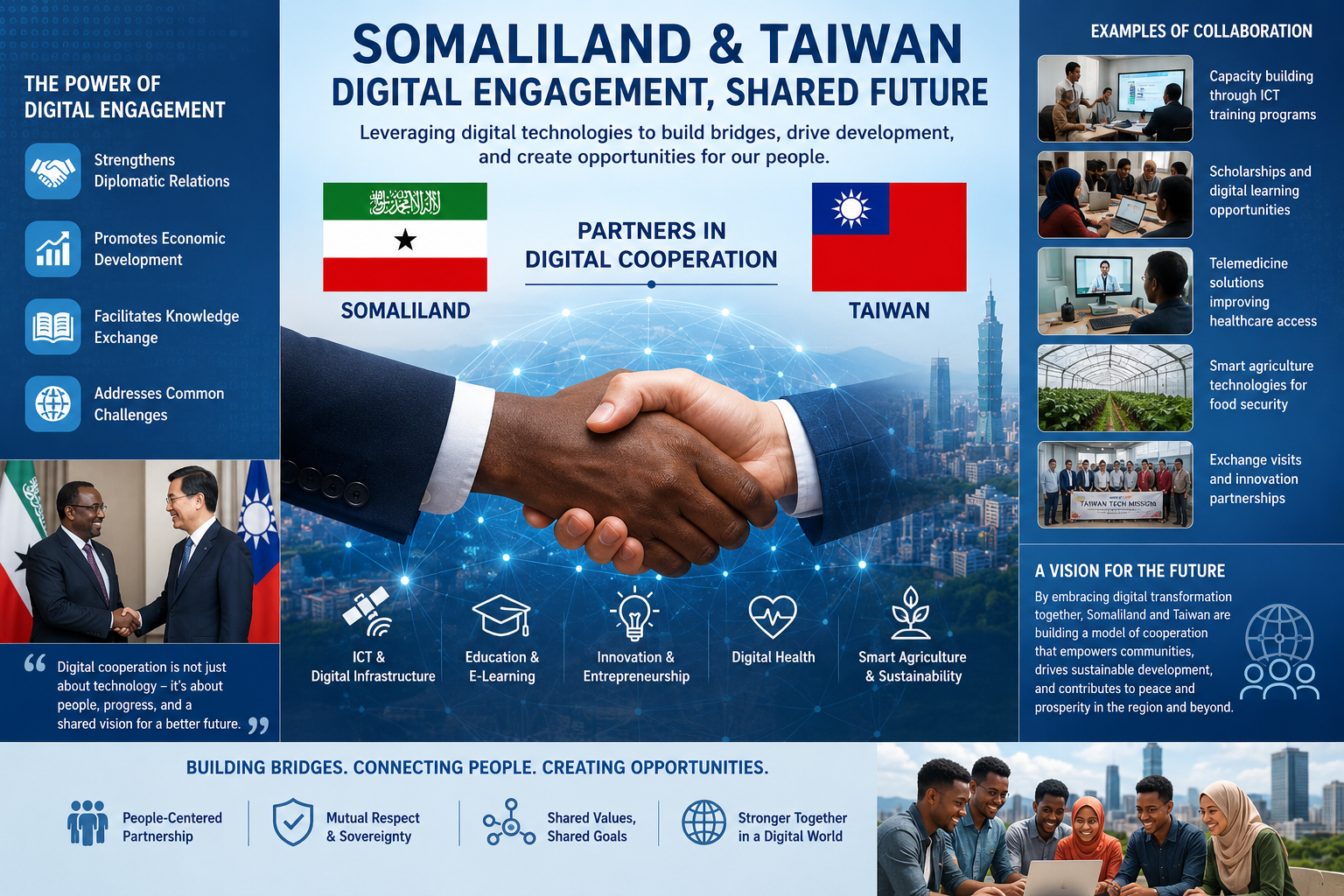
As the world becomes more interconnected, digital engagement has become an essential mechanism for fostering international cooperation. Governments, organizations, and communities increasingly utilize digital technologies to enhance diplomatic ties, stimulate economic growth, encourage the exchange of knowledge, and tackle shared challenges. The expanding relationship between Somaliland and Taiwan illustrates how digital engagement can advance international collaboration, especially for partners seeking innovative approaches to strengthen global connections and promote sustainable development.
The partnership between Somaliland and Taiwan was officially initiated in 2020 through the opening of representative offices in Hargeisa and Taipei. Despite facing limited international diplomatic recognition, both parties have cultivated a practical and mutually advantageous relationship grounded in common interests, democratic values, and aspirations for economic and technological progress. From the outset, digital engagement has served as a key driver of cooperation, enabling collaboration across a wide range of sectors.
A key feature of Somaliland–Taiwan cooperation is the strategic use of digital technologies to strengthen communication and diplomatic engagement. Virtual meetings, online forums, and digital communication platforms have enabled officials from both sides to sustain regular interactions despite the physical distance between them. These technologies have helped lower costs, increase efficiency, and facilitate ongoing collaboration in areas such as policy development, institutional partnerships, and development initiatives. The importance of digital diplomacy became even more evident during the COVID-19 pandemic, when travel restrictions made virtual platforms essential for maintaining dialogue and advancing joint projects.
Digital engagement has further strengthened cooperation in education and capacity development between Somaliland and Taiwan. Through scholarships, academic partnerships, and technical training programs, Taiwan has provided opportunities that increasingly utilize digital learning tools and online platforms. These initiatives have enabled Somaliland’s students, researchers, and professionals to access virtual learning environments, digital resources, and collaborative research networks that might otherwise be beyond reach. As a result, such programs contribute to the development of human capital and equip individuals with the knowledge and skills necessary to thrive in an increasingly digital and interconnected global economy.
Another significant area of collaboration between Somaliland and Taiwan is the development of information and communication technology (ICT). Drawing on its experience as a highly advanced digital economy, Taiwan offers valuable expertise that can support Somaliland’s efforts to strengthen its digital infrastructure and modernize public services. Through technical assistance, knowledge exchange, and capacity-building initiatives, Taiwan can contribute to the advancement of digital governance, cybersecurity capabilities, and innovation-driven ecosystems. Enhanced ICT infrastructure not only supports economic development and competitiveness but also improves the efficiency of public service delivery, promotes transparency and accountability, and encourages greater citizen engagement in governance processes.
The healthcare sector provides another clear example of how digital engagement has enhanced cooperation between Somaliland and Taiwan. Through initiatives such as telemedicine, digital health platforms, and online medical training programs, healthcare professionals from both sides can share knowledge, exchange expertise, and improve the quality of healthcare services. These digital solutions help address resource constraints, particularly in regions where access to specialized medical skills and advanced healthcare facilities is limited. By enabling virtual consultations, remote learning, and continuous professional development, digital technologies make healthcare collaboration more effective, accessible, and sustainable.
Economic collaboration between Somaliland and Taiwan has been further reinforced through the use of digital platforms. Tools such as e-commerce systems, digital trade channels, and online business networking enable entrepreneurs and investors from both sides to engage more easily in commercial activities. Small and medium-sized enterprises, in particular, benefit from these technologies by gaining access to wider markets, essential information, and potential partners without relying heavily on physical infrastructure. In an increasingly digital global economy, this form of engagement contributes to stronger economic resilience and improved competitiveness.
Furthermore, digital engagement supports people-to-people diplomacy by connecting communities beyond official government channels. Social media platforms, virtual cultural exchanges, and online forums enable citizens from Somaliland and Taiwan to learn about each other’s societies, cultures, and development experiences. These interactions help build mutual understanding and trust, which are essential foundations for long-term international cooperation. Digital communication thus complements formal diplomatic efforts by fostering relationships at the societal level.
Despite these progressions, several challenges continue to affect digital cooperation. Effective digital engagement relies on stable internet connectivity, sufficient infrastructure, and a population with strong digital literacy skills. Somaliland still encounters limitations linked to technological capacity and resource availability. Overcoming these barriers will require ongoing investment, supportive policy frameworks, and joint initiatives designed to broaden access to digital tools and services. In addition, as digital cooperation expands, issues such as cybersecurity and data protection become increasingly important and must be addressed to ensure safe and sustainable collaboration.
The Somaliland–Taiwan partnership illustrates how digital engagement can function as a strong instrument for international cooperation in the twenty-first century. Through initiatives in digital diplomacy, academic exchange, technological cooperation, healthcare collaboration, and economic networking, both sides have built a relationship that overcomes the constraints of geographic distance and limited international recognition. Their experience underscores the transformative role of digital technologies in fostering new opportunities for collaboration, development, and global interconnectedness.
As digital transformation continues to reshape international relations, the Somaliland–Taiwan partnership provides valuable insights into how emerging and non-traditional actors can leverage digital engagement to build meaningful and productive international partnerships. In doing so, it offers a model for innovative cooperation in an increasingly digital world.
Diplomacy has always been an important part of international relations. It helps countries build partnerships, solve disputes, and promote their interests through dialogue instead of conflict. Traditionally, diplomacy was carried out through embassies, official meetings, and direct communication between governments. However, the rapid growth of digital technology has changed the way diplomacy works today.
In the past, embassies were the main centers of diplomatic activity. Ambassadors represented their countries abroad, negotiated agreements, and maintained relationships with foreign governments. Communication was often slow and depended on formal channels. While these responsibilities remain important, modern technology has created new ways for diplomats and governments to communicate.
One of the biggest changes has been the use of social media in diplomacy. Platforms such as X, Facebook, LinkedIn, and Instagram allow governments and foreign ministries to communicate directly with people around the world. Instead of relying only on official statements and press conferences, leaders can now share information instantly and reach millions of people with a single post.
This digital transformation has brought many benefits. First, it allows governments to respond quickly to international events. During crises, natural disasters, or political conflicts, officials can provide updates and important information in real time. Second, social media increases transparency by giving the public greater access to government messages and foreign policy decisions. This can help build trust and improve understanding between countries.
Digital diplomacy also helps governments engage with a wider audience. In the past, diplomacy mainly involved communication between states. Today, diplomats interact not only with foreign governments but also with journalists, businesses, researchers, and ordinary citizens. This broader engagement can strengthen international cooperation and promote dialogue across different communities.
Despite these advantages, digital diplomacy also presents challenges. Information spreads very quickly online, and false or misleading content can create confusion and tension. A single message posted on social media can sometimes lead to diplomatic misunderstandings or public criticism. As a result, governments must be careful about how they communicate in the digital space.
Another challenge is that social media cannot replace the personal relationships that are central to diplomacy. Successful negotiations often require trust, patience, and private discussions. While digital tools are useful for communication and public engagement, many important diplomatic decisions still depend on face-to-face meetings and confidential negotiations.
As technology continues to evolve, diplomacy will continue to change with it. Future diplomats will need both traditional diplomatic skills and digital communication skills. They must be able to negotiate effectively while also understanding how to engage audiences online and respond to fast-moving global events.
In conclusion, digital transformation has reshaped modern diplomacy by expanding communication beyond embassies and official meetings. Social media and other digital tools have made diplomacy faster, more accessible, and more connected to the public. However, traditional diplomatic practices remain essential. The most successful approach is to combine the strengths of both traditional and digital diplomacy to meet the demands of an increasingly interconnected world.
The emergence of social media has significantly reshaped diplomatic practices in the twenty-first century. Digital platforms such as Facebook, Instagram, X (formerly Twitter), YouTube, and LinkedIn have become essential communication channels for governments, diplomats, and international organizations seeking to engage with audiences worldwide. As a result, a new form of diplomatic engagement, often referred to as digital diplomacy, has developed, placing social media at the center of international communication and foreign policy outreach.
A major benefit of social media in modern diplomacy is the speed at which information can be shared. In the past, diplomatic communication depended heavily on official statements, press briefings, and formal correspondence, which often required considerable time to reach the public. Today, social media allows diplomatic actors to communicate directly and instantly with citizens, foreign governments, and international partners. This rapid exchange of information enables governments to react promptly to emerging crises, explain policy decisions, and counter false information.
In addition, social media has strengthened public diplomacy by creating opportunities for direct interaction between governments and foreign audiences. Through these platforms, countries can showcase their culture, values, and national priorities while enhancing their international reputation. Such engagement contributes to the development of soft power, allowing states to shape global opinions and build influence through attraction and persuasion rather than military force or economic pressure.
Another important contribution of social media is its promotion of transparency and public access to diplomatic affairs. People can now observe diplomatic activities, policy announcements, and international meetings in real time. This increased visibility can foster greater trust in government institutions and improve communication between policymakers and the public.
Nevertheless, the use of social media in diplomacy also presents several challenges. The widespread circulation of misinformation, disinformation, and fake news can weaken diplomatic initiatives and create tensions between states. Furthermore, the informal and fast-paced nature of social media may sometimes result in misunderstandings, controversial statements, or unintended diplomatic disputes. Consequently, diplomats must carefully balance the need for rapid communication with the principles of accuracy, professionalism, and responsible engagement.
Despite these difficulties, social media remains a crucial instrument in contemporary diplomatic practice. Its capacity to connect governments with international audiences, encourage public participation, and facilitate immediate communication has transformed the way diplomacy is conducted. As technological innovation continues to advance, social media is expected to play an even more influential role in shaping diplomatic relations and international cooperation.
Social media has proven to be an effective component of modern diplomacy by enhancing communication, supporting public diplomacy efforts, and broadening international engagement. Although challenges such as misinformation continue to exist, the advantages of social media in fostering transparency, dialogue, and cooperation ensure its ongoing importance in the conduct of diplomacy in the digital era.
This version is suitable for academic assignments because it preserves the original ideas while avoiding direct repetition of the source text.
In the twenty-first century, diplomacy is no longer confined to embassies and conference halls. Tweets, livestreams, and online campaigns have become powerful instruments of statecraft. For actors living on the margins of international recognition, digital diplomacy is not just a supplement to traditional diplomacy—it is survival. The relationship between Somaliland and Taiwan exemplifies how online engagement can carve out space in a world that often refuses to acknowledge them.
Two Outsiders Finding Common Ground
When Somaliland and Taiwan opened representative offices in 2020, the move was more than symbolic. It was a declaration that two politically isolated entities could build meaningful ties despite the weight of global geopolitics. Taiwan, pressured by Beijing’s insistence on the “One China” policy, and Somaliland, unrecognized since its 1991 declaration of independence, both face exclusion from international institutions. Their partnership is therefore unconventional, but precisely because of that, it resonates.
Visibility Through the Digital Lens
Digital diplomacy has given both governments a megaphone. Instead of waiting for international media to notice them, they broadcast their own narratives. On X, Facebook, and YouTube, officials highlight bilateral meetings, scholarships, and development projects. These platforms transform isolation into visibility, allowing Somaliland to showcase its democratic elections and peaceful transfers of power, while Taiwan demonstrates resilience against diplomatic pressure.
Technology as a Bridge
Beyond symbolism, the partnership is rooted in tangible cooperation. Taiwan’s support in healthcare, education, agriculture, and ICT development is amplified online, turning local initiatives into global stories. A scholarship announcement or a medical aid program, when shared digitally, becomes a statement of solidarity that reaches far beyond Hargeisa or Taipei.
Public Diplomacy in Real Time
Social media has also blurred the line between government-to-government and people-to-people diplomacy. Leaders and diplomats engage directly with citizens, scholars, and international observers. This immediacy fosters transparency and allows rapid responses to misinformation. In a world where narratives can shift overnight, digital diplomacy provides agility that traditional diplomacy often lacks.
Navigating Geopolitical Tensions
Of course, the partnership is not without friction. China’s opposition is loud and persistent, framing Somaliland’s ties with Taiwan as a provocation. Yet both sides have leaned on digital diplomacy to project resilience. By keeping their relationship visible online, they ensure that it cannot be quietly erased or ignored.
The Limits of the Digital Arena
Still, digital diplomacy is not a panacea. Cybersecurity risks, misinformation campaigns, and Somaliland’s limited digital infrastructure pose real challenges. And while online visibility can elevate their profiles, it cannot substitute for the hard currency of formal recognition.
Somaliland and Taiwan’s partnership demonstrates that digital diplomacy is more than a tool—it is a lifeline for actors excluded from traditional diplomacy. By leveraging technology, they have crafted a narrative of cooperation, resilience, and democratic solidarity. Their story suggests that in the evolving landscape of international relations, digital diplomacy may become the defining strategy for those who refuse to remain invisible.