
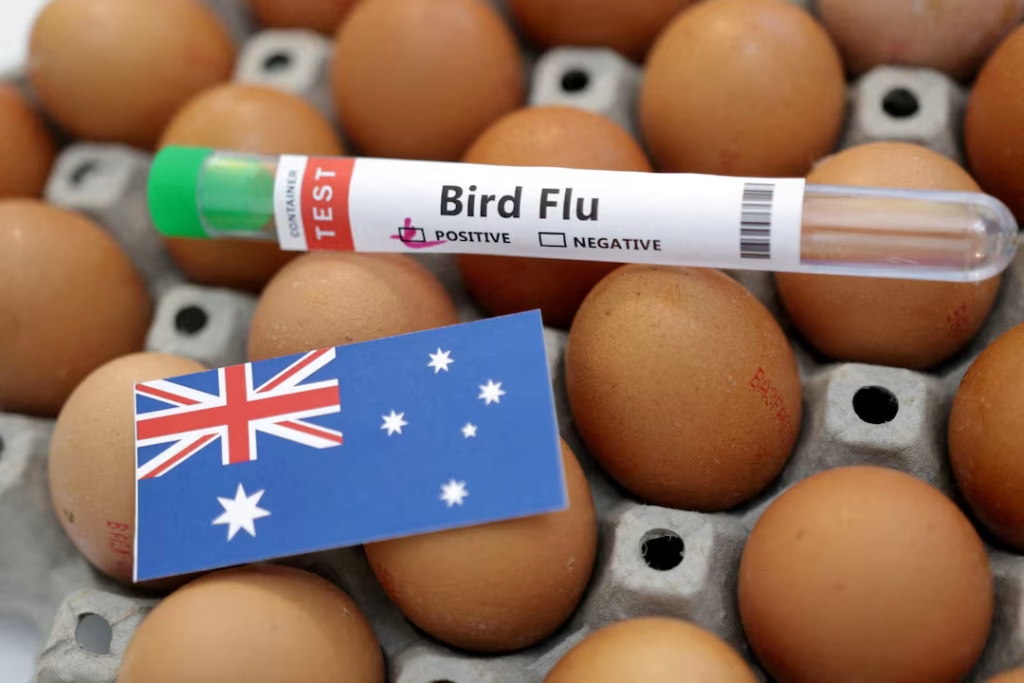
Australia on Friday confirmed the first case of the deadly H5N1 bird flu virus in a local seabird, saying it was also testing a dead seal for a possible infection, raising concerns that the disease is beginning to spread more widely after it landed in the country last month.
Laboratory testing by Australia’s national science agency confirmed the virus was present in a greater crested tern found in the South Australian coastal town of Robe, Agriculture Minister Julie Collins said.
It brings the total number of positive detections in the country to 12, after authorities on Friday also confirmed two additional infections in South Australia and one in Western Australia.
Collins said the development was “concerning” but not unexpected, adding that there was still no evidence of mass mortalities or spread to other animal populations and the poultry or agriculture sector.
“Our scientists are undertaking further work to establish the potential pathway that resulted in the Australian seabird’s infection,” she said.
“What we do know is that this is a coastal seabird that has an overlapping coastal range with migratory seabirds that have previously tested positive for H5.”
The virus spreading to a local seabird was “very bad news,” said Hamish McCallum, an infectious diseases ecologist at Griffith University.
It’s likely that this will be the beginning of many more cases,” he said.
H5N1 testing was also underway for samples from a young fur seal that died on Thursday in the Central Coast of New South Wales, a spokesperson from the environment department said.
A positive result would mark mainland Australia’s first confirmed H5N1 case in a mammal.
New South Wales was the country’s third state to detect H5N1, after a migratory seabird in the Mid North Coast tested positive earlier this month.
The virulent strain of bird flu has spread through wild bird and mammal populations since 2021, killing millions, infecting poultry and dairy farms and even some farmworkers.
Australia in June became the final continent to confirm a mainland-based case of H5N1, although the virus had been detected in late 2025 on the sub-Antarctic territory of Heard Island, about 4,100 km (2,600 miles) from continental Australia.
Scientists believe the virus has killed around 13,000 seal pups on Heard Island.
Source Reuters