
Can Saudi Arabia Rely More on Somaliland or Somalia? The Strategic Alignment Between Riyadh and Hargeisa in the Red Sea Security Competition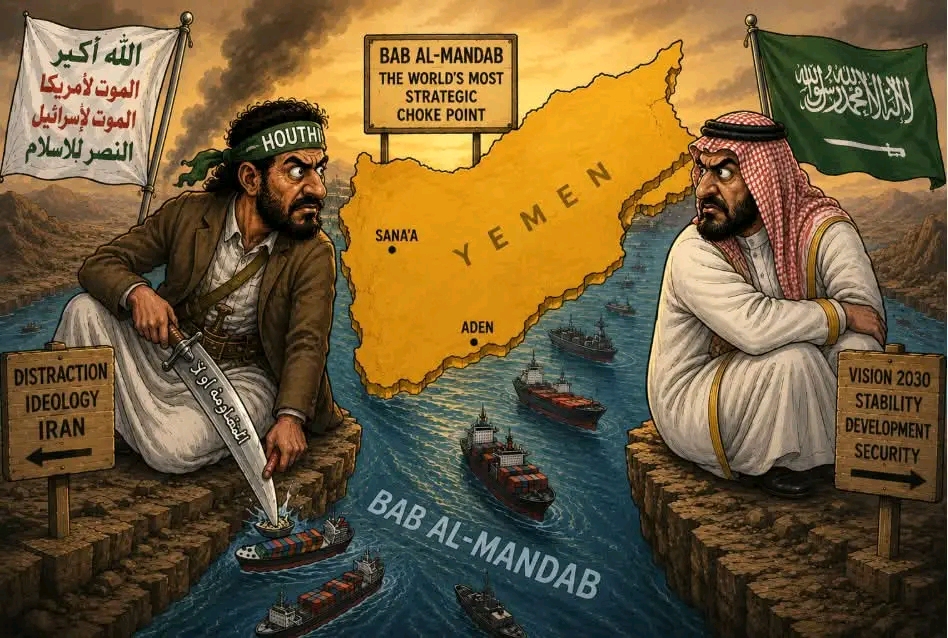
The future security of the Red Sea is becoming one of the most important strategic questions in global geopolitics. For Saudi Arabia, the issue is not only about diplomacy but about securing critical maritime lifelines that directly affect its economic and national security interests.
The Kingdom’s security environment increasingly overlaps with the concerns of the United States and Israel:
– protecting freedom of navigation,
– preventing disruption of international trade routes,
– and limiting the expansion of hostile influence around strategic waterways.
This shared strategic concern explains why Somaliland’s location has attracted growing international attention. The same geographic factors that make Somaliland valuable its position along the Gulf of Aden, proximity to the Bab el-Mandeb Strait, and access to major shipping routes also make Somaliland relevant to Saudi Arabia’s broader Red Sea security calculations.
The central strategic question is therefore:
What comparative value does Somaliland offer Saudi Arabia relative to Somalia?
A stable and internationally integrated Somaliland will contribute to maritime security, reinforce regional stability, and indirectly protect Saudi Arabia’s economic and strategic interests while complementing the wider security objectives of its international partners.
Saudi Arabia’s Red Sea Security Challenge
Saudi Arabia operates within a complex regional balance of power where economic interests and national security are closely connected to competition involving Iran, the United States, Israel, and Iran-aligned actors.
As the leading Arab Gulf power, Saudi Arabia has increasingly focused on safeguarding the Red Sea and Gulf of Aden, which serve as essential maritime routes for global trade, energy transportation, and regional connectivity.
Although Saudi Arabia and Iran restored diplomatic relations, their strategic competition continues. The rivalry extends beyond conventional military competition and includes geopolitical influence, economic interests, ideological differences, and control of strategic geography.
Iran and its regional partners have historically challenged Saudi Arabia’s regional influence, opposed its leadership role within the Arab and Islamic worlds, and sought to expand their strategic presence across the Middle East. This influence has developed through political alliances, ideological networks, and security partnerships that have created strategic pressure points around Saudi Arabia from multiple directions.
Examples include:
– Manama, Bahrain: Iran has historically sought influence among Bahrain’s Shi’a population, while Saudi Arabia views Bahrain’s stability as a key security concern due to its geographic proximity to Saudi Arabia’s Eastern Province and the Gulf region.
– Baghdad, Iraq: Iran has developed significant political and security influence in Iraq through allied political movements and armed groups, making Baghdad one of Tehran’s most important regional influence centres.
– Damascus, Syria: Iran’s support for the Syrian government has enabled Tehran to maintain a strategic presence in Syria, strengthening its regional network and connection toward Lebanon.
– Beirut, Lebanon: Through its long-standing relationship with Hezbollah, Iran has maintained a powerful political and military partner in Lebanon, providing Tehran with influence on the eastern Mediterranean and another strategic position within the wider regional competition.
– Sana’a, Yemen: Through its support for the Houthis, Iran has developed influence on Saudi Arabia’s southern border while enabling a partner capable of threatening maritime security around the Bab el-Mandeb Strait and the Red Sea.
Together, these influence networks create a complex strategic environment for Saudi Arabia. Iran’s regional partnerships extend across land corridors from Iraq and Syria to Lebanon, while also reaching maritime pressure points through Yemen and the Red Sea.
Geographically, Saudi Arabia finds itself surrounded by multiple strategic challenges:
– political influence networks to the north and northeast,
– security pressures along its southern border,
– and maritime vulnerabilities affecting critical waterways.
This combination of land-based and maritime competition has increased Riyadh’s focus on strengthening regional partnerships, protecting strategic corridors, and preventing further expansion of hostile influence around its security environment.
This competition has included attempts to develop influence among Shi’a communities in parts of the Gulf, including Saudi Arabia’s Eastern Province, although the political and military influence of these communities remains limited.
However, the most significant security challenge for Saudi Arabia increasingly involves maritime chokepoints.
Saudi Arabia’s Three Strategic Maritime Pressure Points
Saudi Arabia’s security depends heavily on three major maritime corridors that connect the Gulf region with global markets.
1- The Strait of Hormuz
The Strait of Hormuz is one of the world’s most important energy routes. A significant portion of Gulf energy exports passes through this narrow waterway before reaching international markets.
Iran holds substantial geographic and military influence around Hormuz because of its coastline, naval capabilities, and proximity to the strait.
For Saudi Arabia, Iran’s ability to pressure this corridor represents a major strategic vulnerability.
2- The Bab el-Mandeb Strait
The Bab el-Mandeb represents the most immediate Red Sea security challenge.
This narrow maritime corridor connects the Gulf of Aden with the Red Sea and serves as a major route for international shipping between Asia, Europe, and the Middle East.
On the Yemeni side, the Houthis have developed military capabilities that allow them to threaten maritime traffic. Their alignment with Iran has increased concerns that the Bab el-Mandeb could become a strategic pressure point in the wider Saudi-Iranian competition.
On the opposite side of this maritime corridor lies the Horn of Africa, where Somaliland occupies a strategically important position.
Unlike Yemen, where the Saudi-Iranian rivalry has contributed to prolonged conflict, political instability, and increased risks to maritime security, Somaliland has maintained relative stability and developed domestic security institutions capable of supporting international cooperation and contributing to regional maritime security efforts.
3- The Suez Canal
The Suez Canal represents the northern gateway of the Red Sea maritime system and one of the world’s most important commercial routes.
Although Egypt controls the canal, its security depends on the stability of the wider Red Sea environment. Any disruption around Bab el-Mandeb can directly affect shipping flows through Suez.
Together, Hormuz, Bab el-Mandeb, and Suez form a connected strategic maritime system. Instability affecting any one of these chokepoints can create consequences for regional security, global trade, and Saudi Arabia’s economic interests.
Historically, Saudi Arabia has relied primarily on diplomatic partnerships rather than a direct strategic presence around these maritime corridors. Its engagement with Somalia, for example, has been based largely on political, religious, and regional considerations, despite Somalia having no operational existence and influence over the security of the Bab el-Mandeb corridor.
Saudi Arabia has also maintained close relations with Djibouti, a country that hosts major international military facilities, including a significant United States presence. Egypt remains another important partner due to its control of the Suez Canal and its strategic relationships with both Western partners and regional actors. These partnerships have largely developed within broader Arab and Islamic diplomatic frameworks rather than through a dedicated Saudi maritime security strategy.
However, Saudi Arabia’s direct security presence and strategic planning around the Horn of Africa and the southern Red Sea have historically remained limited compared with the importance of these waterways to its national interests.
In recent years, Riyadh has shown increasing interest in expanding engagement in the Horn of Africa, including relations with Djibouti, Eritrea, and Ethiopia. However, these efforts face strategic challenges due to political competition, differing regional interests, and complex relationships among those Horn of African states.
This evolving approach highlights a broader strategic question for Saudi Arabia: whether its traditional reliance on diplomatic partnerships is sufficient to protect its interests around critical maritime chokepoints, or whether it requires deeper cooperation with geographically positioned and stable partners closer to the centre of Red Sea security dynamics.
Saudi Arabia, the United States, and Israel: Shared Strategic Concerns
Saudi Arabia, the United States, and Israel maintain different foreign policies and strategic priorities, but they share several important security concerns in the Red Sea region.
These include:
– Protecting international shipping routes.
– Maintaining freedom of navigation.
– Preventing attacks on maritime trade.
– Limiting the expansion of hostile influence around strategic waterways.
The broader competition involving Saudi Arabia, Iran, and Iran-aligned actors has increasingly focused on maritime security.
Iran’s influence around the Strait of Hormuz and the Houthis’ ability to threaten the Bab el-Mandeb corridor represent challenges that affect not only Saudi Arabia but also global trade and the interests of international partners.
This explains why the strategic importance of Somaliland has attracted attention from countries such as the United States, Israel, and the United Arab Emirates.
The importance of Somaliland is not based only on political considerations. It is primarily connected to geography.
Somaliland’s coastal location provides access to the Gulf of Aden and proximity to one of the world’s busiest maritime corridors.
Somaliland’s Strategic Advantage
Somaliland occupies a strategically significant position along the Gulf of Aden, directly overlooking the approaches to the Bab el-Mandeb Strait.
Its coastline places it near a maritime route that connects Europe, Asia, and the Middle East.
However, Somaliland’s strategic value is not based solely on geography.
Over decades, Somaliland has developed:
– Stable political institutions.
– Domestic security structures.
– Relative internal stability.
– Experience cooperating with international partners.
These factors distinguish Somaliland from many other areas in the Horn of Africa.
A stable and internationally integrated Somaliland could contribute to :
– Protecting freedom of navigation.
– Supporting maritime security operations.
– Improving regional intelligence cooperation.
– Strengthening stability around the Red Sea and Bab el-Mandeb corridor.
For Saudi Arabia, Somaliland represents a potential security partner positioned close to one of its most important maritime vulnerabilities.
Somalia’s Strategic Limitations
Somalia remains internationally recognized, but international recognition alone does not create strategic capability.
One of Somalia’s strategic limitations is its geographic position. Although Somalia possesses one of Africa’s longest coastlines along the Indian Ocean, it does not have a coastline directly on the Gulf of Aden or the Bab el-Mandeb corridor, which are the central maritime areas of Saudi Arabia’s Red Sea security concerns.
As a result, Somalia’s ability to directly influence security dynamics around these critical waterways remains limited.
Political instability, internal security challenges, and limited state capacity have reduced Somalia’s ability to influence maritime security dynamics around the region.
Somalia is not currently positioned at the centre of the Saudi-Iranian strategic competition surrounding the Red Sea and Bab el-Mandeb.
Its role remains primarily diplomatic rather than operational.
Strategic geography only becomes valuable when combined with stability, governance capacity, and reliable security institutions.
This is where Somaliland presents a different strategic calculation.
The Strategic Alignment Between Riyadh and Hargeisa
Saudi Arabia’s foreign policy has consistently been shaped by strategic interests rather than ideology alone.
Riyadh has demonstrated a willingness to cooperate with partners that advance its security, economic, and regional objectives.
Somaliland and Saudi Arabia share overlapping interests in:
– Maritime security.
– Protection of trade routes.
– Regional stability.
– Countering destabilizing influence near critical waterways.
Somaliland’s cooperation with Western partners also creates strategic compatibility with Saudi Arabia’s close relationship with the United States.
Greater engagement between Riyadh and Hargeisa would not necessarily require replacing existing relationships. Instead, it could represent a pragmatic approach that recognizes Somaliland’s strategic contribution to Red Sea security.
Conclusion: Strategic Value Will Shape Future Partnerships
The future of the Red Sea will be shaped by actors that can provide stability, strategic access, and reliable cooperation.
Somalia possesses international recognition, but Somaliland possesses a combination of advantages that are increasingly important in modern security competition:
strategic geography, political stability, and proximity to the Bab el-Mandeb corridor.
For Saudi Arabia, the central question is not simply who has diplomatic status, but who can contribute most effectively to protecting one of the world’s most important maritime regions.
As competition around the Red Sea intensifies, Somaliland’s strategic value is becoming increasingly difficult to overlook.
Dr Abdullahi Gaboose