
The US pokes the Dragon: Taiwan plants its flag in Somaliland
The Taiwan–Somaliland security alliance exposes new fault lines in the US–China rivalry, pitting regional actors against one another across the Bab al-Mandab and Gulf of Aden
 Photo Credit: The Cradle
A new player has entered the Horn of Africa. On 24 July, Taiwan signed a maritime security agreement with Somaliland, a self-declared state unrecognized by the international community since its 1991 split from Somalia – but one that is increasingly courted for strategic partnerships by US-allied parties. While the pact may appear minor, it carries significant geopolitical weight: opening a new front in Washington’s long war to curtail Beijing’s global rise.
Taiwan’s ambitions in Somaliland stretch far beyond bilateral ties. According to its own framing, the agreement aims to build a “non-red coast” aimed at countering China’s influence along the Red Sea, Gulf of Aden, and Bab al-Mandab Strait.
This is where Israel, the UAE, Turkiye, and the Ansarallah-aligned Yemeni government in Sanaa intersect in both conflict and commerce, transforming Somaliland into a pivotal node in the West Asian–East African contest between Eurasian multipolarity and Atlanticist hegemony.
Taiwan’s Red Sea outpost
Taiwan’s diplomatic overture to Somaliland dates back to 2020, when it opened a representative office in the capital, Hargeisa. The move triggered Beijing’s ire, which condemned it as a violation of the “One China” principle. In response, Taipei and Hargeisa began deepening ties through successive agreements, culminating in the recent security pact.
The current agreement spans three tiers of cooperation. First, it focuses on maritime security, including joint training exercises, search-and-rescue coordination, and the exchange of technical expertise. Second, it addresses the development of the blue economy through collaboration in fisheries exploitation, sustainable coastal management, and maritime logistics. Finally, it involves technology transfer and capacity-building, such as providing surveillance systems, equipment for the coast guard, and Taiwanese technical support.
Somaliland’s 850-kilometer coastline along the Gulf of Aden gives it strategic access to one of the world’s most vital shipping lanes. For US ally Taiwan, it offers both geopolitical leverage and symbolic defiance of Beijing. But for China, the agreement is a provocation. Alongside Somalia, Beijing has rejected the pact outright, calling it a breach of sovereignty and a threat to regional stability.
“The Somaliland regional authority’s action has blatantly violated the one-China principle and harmed China’s sovereignty, unity, and territorial integrity,” the Chinese Embassy in Somalia stated, adding “The Chinese side is resolutely opposed to this action.”
China’s presence in the Horn is anchored in its Djibouti military base (its first overseas installation) through which it monitors and secures Belt and Road Initiative (BRI) shipping corridors. The base offers Beijing a launchpad for economic and military projection into the Red Sea and East Africa. It also places Chinese forces in proximity to US bases, intensifying a region-wide scramble for influence.
Somaliland’s bet on Taipei is undoubtedly a bold move. Lacking formal recognition, Hargeisa is leveraging this alliance to amplify its international relevance and draw itself into Washington’s orbit. The move is emblematic of a broader regional trend in which unrecognized or marginal actors are absorbed into the US-led containment strategy against China in the Global South.
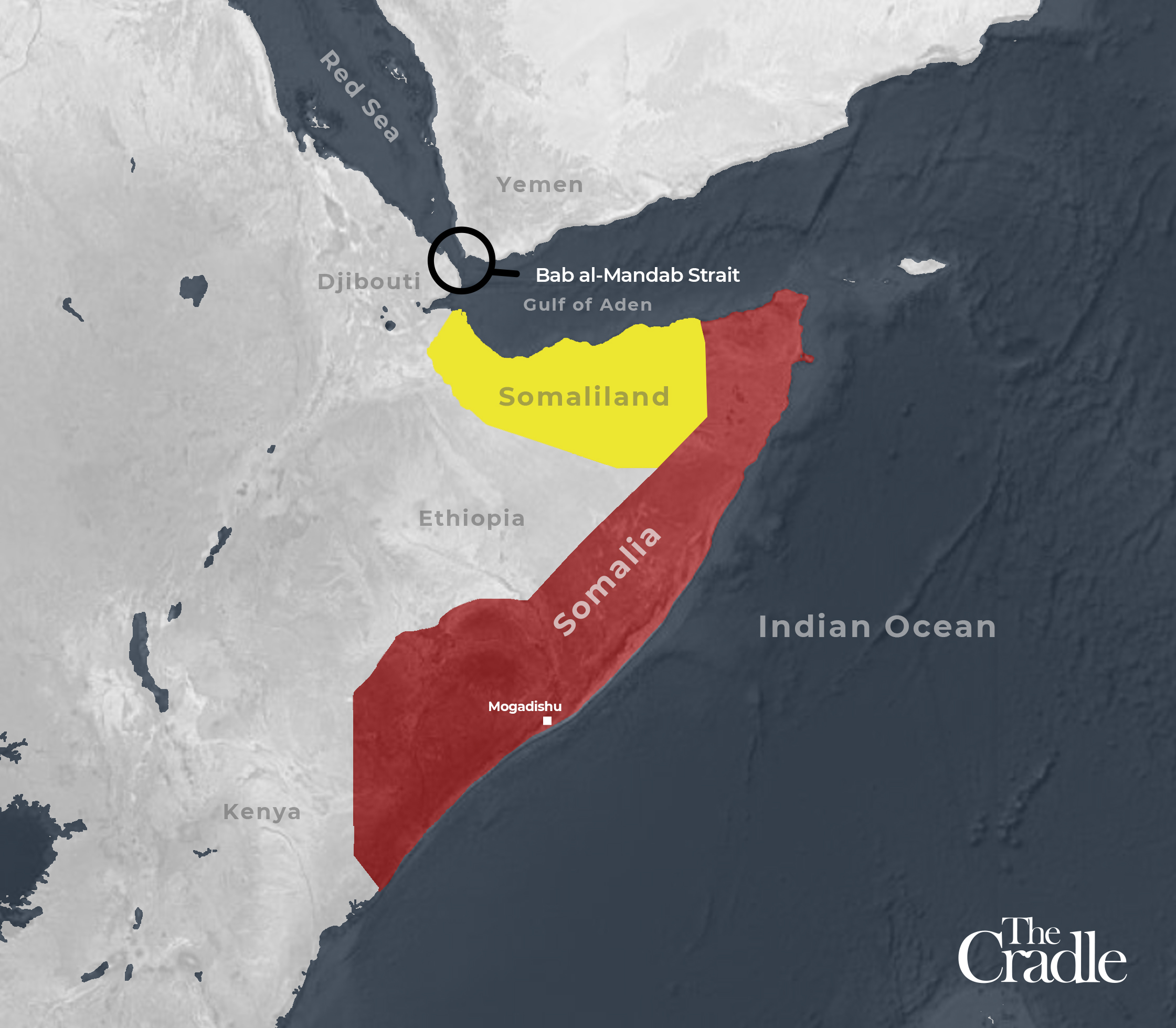
Map of the strategic location of Somaliland.
Proxy politics and containment strategies
While the US has remained publicly silent on the maritime pact, its hand is evident. Taiwanese President Lai Ching-te, during his meeting with a Somaliland delegation, stated that the bilateral partnership could be “strengthened in the future,” by “working with like-minded countries, such as the United States.” In January 2025, the US Congressional Special Committee on China explicitly urged the State Department to establish a representative office in Somaliland to counter Beijing.
This is not just about Taiwan or even Somaliland. The Horn of Africa has become a fault line in the wider US–China confrontation, with maritime security serving as the pretext for projection. Djibouti’s Chinese military base is seen in Washington as a direct challenge to US interests, particularly in surveilling arms flows, monitoring resistance activity in Yemen, and containing Sanaa’s expanding naval reach.
As Somaliland analyst Abdiqadir Jama observes in the Horn Diplomat, the Taiwan–Somaliland alliance is a geopolitical maneuver nested within a larger US–China contestation. Its framing as a “model” for US engagement in the region signals Washington’s intent to forge proxy relationships rather than direct presence.
“Somaliland’s strategy is to leverage great power competition as a pathway to recognition. It recognizes that formal recognition from major powers is unlikely in the near term due to the international community’s adherence to a ‘One-Somalia’ policy and deference to the African Union.”
For Taiwan, the Somliland pact represents “a cornerstone of President Lai Ching-te’s proactive and assertive foreign policy. Facing a relentless campaign of diplomatic strangulation by Beijing, which has left it with only a handful of formal allies, Taipei has developed an offensive strategy of ‘non-recognition diplomacy.’
This development aligns with post-election statements from US President Donald Trump indicating his administration’s intent to recognize Somaliland, a move framed by his close advisors as advantageous for US intelligence operations in the region. These include monitoring Ansarallah-aligned naval activity, arms flows through the Bab al-Mandab, and Chinese logistics.
Resistance axis counterweights
Sanaa has become a decisive actor in this emerging contest. As the only force directly challenging the US military presence and Israeli interests in the Red Sea, the Ansarallah-led government has asserted itself both as a sovereign resistance authority and as an indirect strategic counterweight aligned with Beijing’s interests. Beijing has so far avoided an overt response to the Taiwan–Somaliland deal, but future moves may well include support for countermeasures channeled through Sanaa or other allied partners.
China has yet to extend formal recognition to Sanaa, but it has maintained open channels with the Ansarallah leadership, hosting an Ansarallah delegation as far back as 2016 and exploring limited avenues of coordination. This balancing act allows Beijing to safeguard its shipping corridors without overtly clashing with Washington’s regional partners, yet it leaves open the possibility of a shift toward recognition should US pressure intensify.
For Washington, the pact is another attempt to use unrecognized entities and disputed zones as tools to undercut Chinese and multipolar influence. Yet this approach is fraught with risk. The Gulf of Aden is already a tinderbox, and these new alignments could trigger regional responses that spin beyond US control.
US–Israeli–Emirati axis
Taiwan is not the only US-aligned actor embedding itself in Somaliland. The UAE, a longstanding supporter of Hargeisa’s ruling authorities, is brokering a military deal to grant Tel Aviv a base in Somaliland in exchange for formal recognition. The move seeks to outflank Sanaa by securing a foothold opposite Yemen’s western coast, near the Red Sea chokepoint.
Israel, which already operates a joint intelligence facility with the UAE on Yemen’s Socotra island, is now planning for its Somaliland base to sit alongside Taiwan’s presence under the same US security umbrella. At the same time, Abu Dhabi’s expanding footprint is also intended to counter Turkiye’s military-security ambitions in Somalia, with which it has repeatedly clashed.
What emerges is a dense web of alignments: a US-led bloc comprising Taiwan, Israel, the UAE, and Somaliland, positioned against Chinese, Turkish, and Ansarallah-backed interests. Somaliland, once a peripheral actor, has become a staging ground for proxy confrontation, its unrecognized status exploited to reshape the region’s balance of power.
The consequences will extend far beyond the Horn of Africa. With Taiwan acting as a wedge in the Red Sea, and resistance actors like Sanaa holding maritime lines against western encroachment, the Taiwan–Somaliland pact may well mark the opening salvo in a new phase of multipolar realignment, one that connects Africa’s coasts to the heart of West Asia’s resistance front.
Abdi azlz Al-zin