‘The EU is against the will of the Somaliland people’
“They blindly believe they can force the people of Somaliland to reunite with the fake government of Somalia,” says Somaliland’s representative in Brussels.
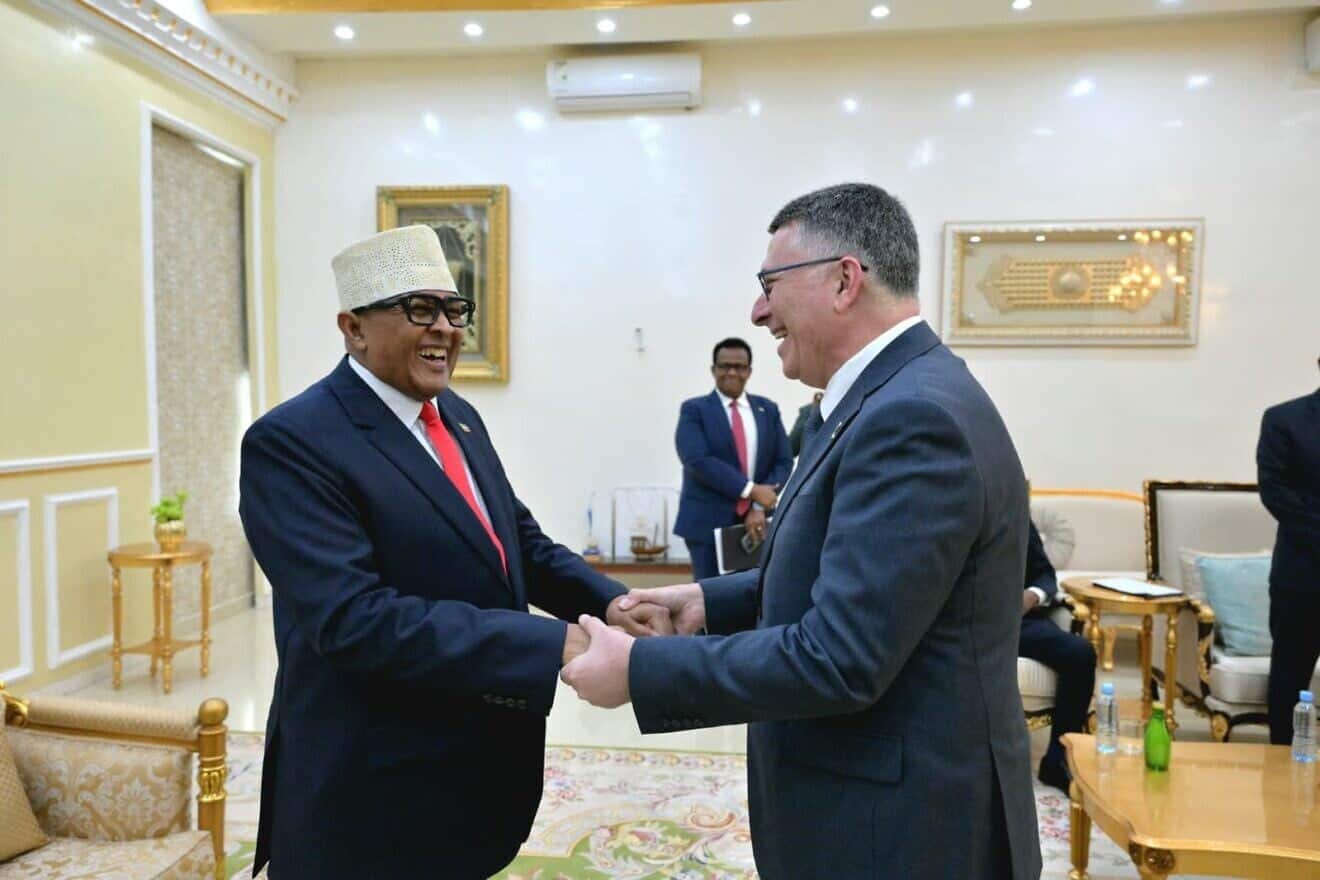
On Dec. 26, Israel became the first country to recognize the independence of Somaliland.
Israel and Somaliland signed an agreement on mutual recognition and the establishment of full diplomatic relations.
On Dec. 27, E.U. foreign affairs spokesman Anouar El Anouni said the bloc “reaffirms the importance of respecting the unity, the sovereignty and the territorial integrity of the Federal Republic of Somalia.”
On Jan. 6, Israeli Foreign Minister Gideon Sa’ar visited Somaliland, the first official visit by a senior Israeli leader to the Horn of Africa country.
Sa’ar visited Hargeisa, the capital of Somaliland, at the invitation of the country’s President Abdirahman Mohamed Abdullahi.
Somaliland first gained its independence in 1960 from British Colonial rule. Israel was then among the 35 countries to recognize an independent Somaliland. However five days later, Somaliland’s government chose to unify with the former Italian colony to form Somalia.
Following civil war in the 1980s, Somaliland once more declared independence in 1991. Since then it has functioned as a de facto state, but unrecognized by most of the international community. Israel’s recognition of Somaliland was a major diplomatic breakthrough for the country.
Unlike Somalia, where the Islamist terrorist group Al-Shabaab threatens the central government, Somaliland is calm and stable. Over the last 20 years it has maintained a functioning multi-party democratic system with regular elections. Its closest international partners are Taiwan and the United Arab Emirates.
Somaliland is located on the shores of the Gulf of Aden. Its geographical location is a major advantage. More than 10% of global maritime trade and nearly a third of oil exports pass through this region. It controls access to the Red Sea and the Suez Canal, as well as the Israeli port of Eilat.
With Iranian-backed militias in Yemen threatening shipping lanes and extremist groups seeking footholds along the Red Sea, Israel has a clear interest in cultivating reliable partners along this corridor. A friendly, stable Somaliland contributes directly to maritime security and helps counter the destabilizing ambitions of Tehran and its proxies.
Israel’s recognition of Somaliland was condemned and even triggered an emergency meeting of the U.N. Security Council. The move was chiefly criticized by China and Turkey.
How did the EU react to Israel’s recognition?
In his statement quoted above, spokesperson El Anouni reaffirmed “the importance of respecting the unity, the sovereignty and the territorial integrity of the Federal Republic of Somalia pursuant of its constitution, the Charters of the African Union and the United Nations.
“This is key for the peace and stability of the entire Horn of Africa region,” he added.
“The E.U. encourages meaningful dialogue between Somaliland and the Federal Government of Somalia to resolve long standing differences,” the statement concluded.
According to Kayse Maxamed, a journalists, analyst and diplomat who represents Somaliland at the E.U. in Brussels (despite the fact that the bloc doesn’t recognize his country), as well as to the Benelux countries, the E.U. “is against the will of the people of Somaliland and they blindly believe that they can force the people of Somaliland to reunite with the fake government of Somalia.
“The policies of the E.U. are outdated and they need to reform,” he told the European Jewish Press.
“Somaliland has a legal, political and moral case to get recognition it deserves,” Maxamed said.
Will the US follow Israel’s example?
Maxamed believes that the U.S. will recognize Somaliland “in due course.”
But there is a lot of pressure from Turkey, Qatar, Saudi Arabia, Djibouti and China to oppose the recognition. Chinese Foreign Minister Wang Yi was to pay a visit to Mogadishu, capital of Somalia, on Friday, but it was postponed. Somali Foreign Ministry officials told Reuters that the reason for the postponement and a future schedule for Wang’s visit would be provided later.
Maxamed said, “We need the U.S. to recognize Somaliland. The Somali government threatened to use military action to force us unite with Somalia. If the U.S. recognizes Somaliland, no one will dare to attack us.”
Israel’s ambassador to the U.N., Danny Danon described the reaction of countries that condemned Israel’s decision to recognize Somaliland as “a clear case of double standards and hypocrisy.”
He pointed out the inconsistency—when countries unilaterally recognize a Palestinian state, it is accepted without discussion or objection. “But when Israel exercises its sovereign right to recognize Somaliland, a stable, democratic entity that has functioned independently for over three decades—the [Security] Council rushes to convene an emergency session. This reveals the persistent bias and hypocrisy of certain members,” he said.
“Unlike ‘Palestine’, Somaliland is not a virtual state. It’s a functioning state. Somaliland is a fully-functioning country based on the principles of international law. Somaliland is—and has been—a stable democracy for nearly 35 years. It has democratic elections—most recently in November 2024—and peaceful transitions of power. It’s pro-Western and friendly to Israel,” the Israeli foreign minister noted.
The U.S. defended Israel’s stance, while clarifying that there had been no change in its own policy toward Somaliland.
Somaliland’s president is expected to soon visit Israel. The two countries are also expected to soon make mutual appointment of ambassadors and the opening of embassies. Somaliland could also soon join the Abraham Accords.
Originally published by the European Jewish Press.