
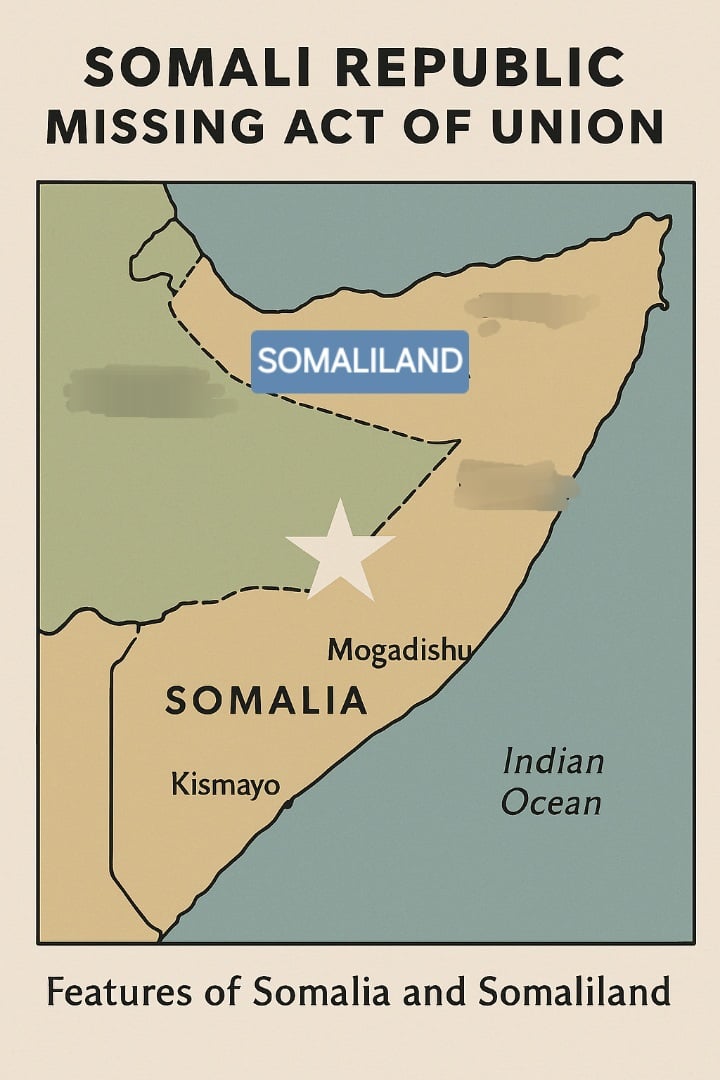
Introduction
The union of Somaliland and Somalia in 1960 created the Somali Republic, a landmark in African decolonization. Yet, the process was marked by haste, legal ambiguities, and unresolved institutional contradictions. Scholars have described it as a precipitate union, reflecting both nationalist aspirations and fragile state-building. This article reconstructs the sequence of events, the legislative instruments, and the integration challenges that followed, drawing on primary records and legal commentary.
Independence Without Legal Groundwork
Neither the United Nations nor the colonial powers assumed responsibility for laying the legal foundations of union. Their role was limited to preparing the territories for independence and transferring authority. Consequently, there was little consultation between the administrations of the North and South in the crucial weeks preceding independence. As Touval observed, “the precipitate union” left several legal loose ends.²²
The Mogadishu Conference and Constitutional Anticipation
At the Mogadishu conference, leaders agreed on broad principles of union. The Constituent Assembly in Mogadishu, on June 18, 1960, incorporated provisions into the Constitution anticipating an Act of Union.³ The plan envisioned that representatives of Somaliland and Somalia would sign a binding international agreement immediately after independence. However, the text from Somaliland arrived late, and the process was rushed.
Divergent Legislative Instruments. Events unfolded differently than anticipated:
June 27, 1960: Somaliland’s Legislative Assembly passed The Union of Somaliland and Somalia Law (Law No. 1 of 1960), declaring perpetual unity in a democratic republic.²⁶ The law contained detailed provisions on citizenship, governance, and succession of rights. However, it was valid only in Somaliland, as Somalia never signed it.
June 30, 1960: Somalia’s Legislative Assembly debated and approved Atto di Unione “in principle,” requesting a definitive single text to be agreed upon with Somaliland. No final text was produced before independence.²⁶
Proclamation of the Somali Republic
At midnight on June 30, Somalia proclaimed independence, and its Constitution came into force. On July 1, representatives from both territories met in joint session as the first National Assembly. The union was proclaimed and sealed by a standing ovation. Aden Abdulla Osman was elected Provisional President. Symbolically, a lawful union was formed by the will of the peoples, but legally, the instruments lacked binding force across both territories.
A last-minute decree-law signed on July 1 attempted to formalize the union, but it was never ratified by the National Assembly as required by Article 63 of the Constitution. Thus, the union’s legal foundation remained incomplete until a new Act of Union was adopted seven months later, retroactively effective from July 1, 1960.²⁷
Integration Problems
Although the Constitution described Somalia as a “unitary Republic,” in practice the two regions remained distinct:
- Legal Systems: Somaliland followed British-derived law (English common law, Indian statutes, local ordinances), while Somalia retained Italian-based law (colonial legislation, trusteeship enactments).
- Languages of Administration: English dominated in the North, Italian in the South, with Arabic occasionally used in both.
- Institutions: Judicial systems, currencies, taxation, education, and civil service structures differed significantly.
- Military and Police: Organization, training, and service conditions varied between the two regions.
To address these disparities, a Consultative Commission for Integration was established in September 1960. The first government, led by Prime Minister Abdirashid Ali Sharmarke, faced the daunting task of harmonizing two distinct colonial legacies into a single national framework.²⁹
Conclusion
The Somali Republic’s formation was both a triumph of nationalist aspiration and a cautionary tale of rushed state-building. The union of Somaliland and Somalia was proclaimed with great enthusiasm, but its legal and institutional foundations were fragile. The hurried process left unresolved contradictions that would later resurface in political disputes and claims of illegitimacy. The story of July 1960 is not only about independence and unity—it is also about the challenges of forging a truly unitary state from two divergent colonial experiences.
References
22. S. Touval, Somali Nationalism: International Politics and the Drive for Unity in the Horn of Africa, Harvard University Press, 1963, p. 110.
23. Verbatim Records of the Proceedings of the Constituent Assembly, June 18, 1960.
26. Law No. 1 of 1960, Union of Somaliland and Somalia Law.
27. Act of Union, adopted January 1961, retroactive to July 1, 1960.
29. Decree of the President of the Republic, October 13, 1960.