Urges Regional Allies to Follow Israel’s Lead
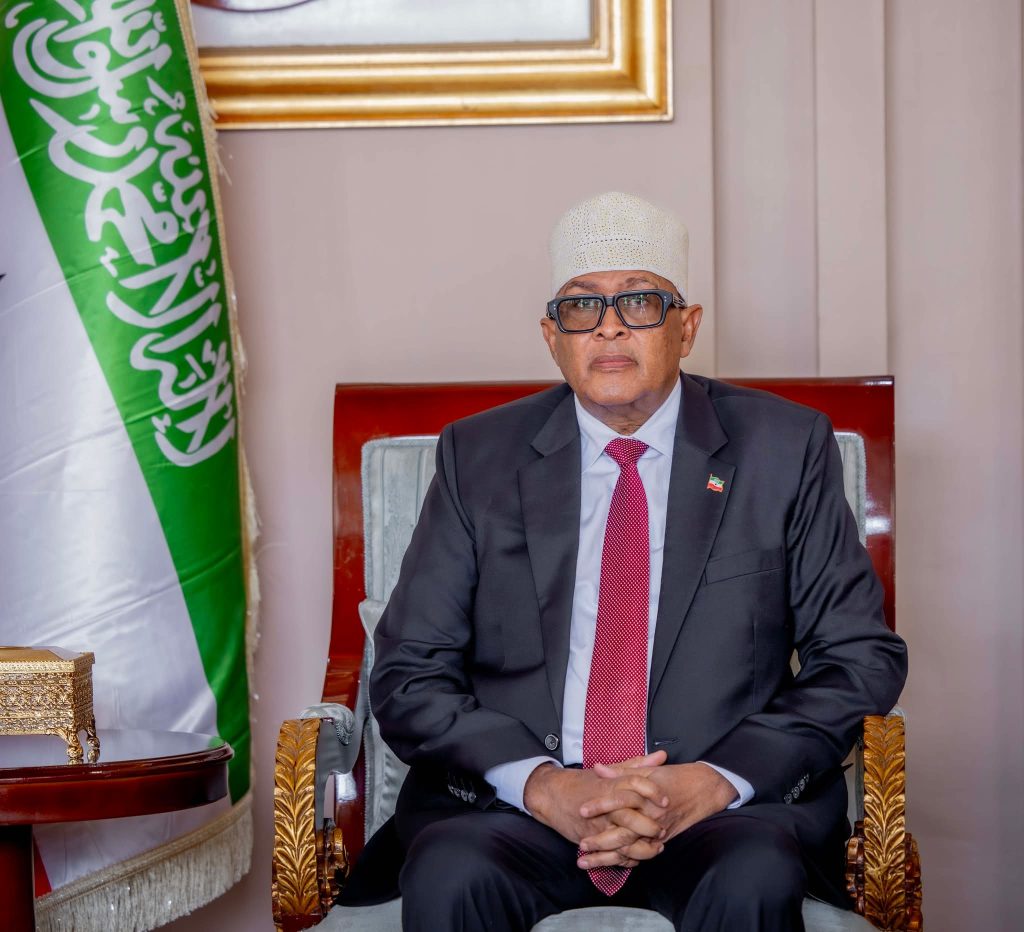
President Abdirahman Mohamed Abdullahi Irro appealed to Ethiopia, Kenya and the United Arab Emirates to formally recognize Somaliland, urging them to follow Israel’s lead in acknowledging the self-declared republic’s sovereignty after more than three decades of diplomatic limbo.
Speaking in Hargeisa, Irro appealed to the international community to recognize what he described as Somaliland’s “legal, historical and moral right” to independence, while urging member states of the African Union to revisit recommendations made by the bloc’s 2005 fact-finding mission to the territory.
The appeal came during celebrations marking the 35th anniversary of Somaliland’s declaration of independence from Somalia in 1991, an event attended by senior government officials and foreign delegations from countries including Ethiopia, Kenya, Taiwan and the United Arab Emirates.
“I am pleased to announce that today, the President of the State of Israel will officially receive the credentials of our ambassador,” Irro said during the ceremony commemorating Somaliland’s 1991 declaration of independence from Somalia.
Israel became the first country to formally recognize Somaliland in late December 2025. Earlier this month, it formally accepted Mohamed Haji (PhD) as Somaliland’s fully accredited ambassador to Israel, making him the territory’s first internationally recognized ambassador.
Although countries including Ethiopia, United Kingdom, United States, Taiwan, Djibouti, Kenya, Turkey, Sweden and the United Arab Emirates maintain representative offices in Somaliland, none has granted full diplomatic recognition.
“Somaliland has never been alone,” Irro said, citing Israel, Ethiopia, the UAE, Taiwan and Kenya among Somaliland’s longstanding partners. “In both good and difficult times, those nations have stood with us,” he added, appealing to them to formally recognize Somaliland’s sovereignty.
The appeal comes as neighboring Somalia faces mounting political uncertainty following the expiration of the mandates of President Hassan Sheikh Mohamud and the federal parliament.
Constitutional ambiguities have fueled debate over whether the Somali president can remain in office in the absence of an elected successor. Negotiations between the federal government and opposition groups have yet to produce a breakthrough, deepening concerns over governance and stability.
Against that backdrop, Irro portrayed Somaliland as a comparatively stable polity. “We are a civilized people who resolve challenges through dialogue and mutual understanding,” he said.
During the celebrations, Somaliland launched the Somaliland Independence Recognition Institute, or SIRI, an organization aimed at advancing the territory’s push for international recognition through diplomatic and legal channels.
Irro described the institute as a body that would pursue Somaliland’s recognition campaign “systematically and relentlessly,” while coordinating international partnerships.
SIRI will be chaired by Gavin Williamson, the former British defense and education secretary and a member of the UK Conservative Party. Jason McCue, a British human rights lawyer and international justice campaigner, will serve as the institute’s director.
The institute also appointed David Carden, an American lawyer, diplomat and mediator who served as the first resident United States ambassador to the Association of Southeast Asian Nations under President Barack Obama, as SIRI’s director of legal affairs.
In remarks delivered during the launch ceremony, Williamson drew a stark contrast between Somalia and Somaliland, recounting a visit he made to Mogadishu while serving as Britain’s defense secretary.
“I remember flying into Mogadishu, a once beautiful city ravaged by war,” Williamson said. “I saw a country divided and consumed by conflict. I saw a president who was not in control of even the capital city, let alone the country.”
Williamson accused Somalia’s political leadership of failing to build functioning state institutions, saying the country appeared “more interested in sustaining itself through conflict and terrorism than building a state to serve its people.”
He contrasted that experience with a later visit to Somaliland, which he described as politically stable and institutionally functional despite lacking international recognition.
“Somaliland is a place we do not formally recognize, yet it seems to be doing so much right,” Williamson said. “For the first time, I saw a nation that placed the value of its people at the center of its agenda.”
He praised Somaliland’s democratic elections, education system and relative political openness, arguing that the territory had embraced many of the principles Western governments often cite as markers of responsible governance.
“It appeared to be doing everything that Western nations ask of societies that seek to be good citizens of the world,” he said.
President Irro used the occasion to renew Somaliland’s appeal for international recognition, calling on the global community to acknowledge what he described as the territory’s “legal, historical and moral right” to sovereignty.
He also urged member states of the African Union to revisit the findings of the bloc’s 2005 fact-finding mission to Somaliland.
“I call upon African Union member states to learn from the tragic consequences caused by forcing together nations and political systems that cannot coexist,” Irro said.
The African Union mission, which visited Somaliland in 2005, described the territory as stable and noted its democratic progress and distinct historical trajectory. While it stopped short of recommending formal recognition, the mission urged the African Union to treat Somaliland as a unique case and consider deeper political engagement, including the possibility of granting it observer status.
Somaliland, a self-governing territory in the Horn of Africa, has operated with its own government, currency and security apparatus since breaking away from Somalia in 1991, though it remains internationally unrecognized by the United Nations and most sovereign states.
Source The Reporter