
The Iran War Makes the Case for the United States to Recognize Somaliland
By Burhan Adam
In December 2025, a journalist asked President Donald Trump whether the United States would recognize Somaliland, as Israel had just done. He answered with a single word: “No.” Then, as he often does, he tossed off a question of his own: “Does anyone even know what Somaliland is?” The jab landed partly because it’s fair – most Americans couldn’t say. But the answer now bears directly on a waterway the war with Iran has thrown into crisis. Somaliland is a stable, self-governing state that has held elections, each followed by a peaceful transfer of power, and kept the peace for thirty-five years. And of strategic significance, it sits on the southern approach to one of the two maritime chokepoints the war has put under strain. Officially recognizing Somaliland would be controversial. Somalia regards it as part of its territory, and nearly every member of the United Nations recognizes Somalia’s territorial integrity. But Somaliland reclaimed its sovereignty in 1991, after the collapse of the central Somali state, and has governed itself independently ever since. Israel was the first country to recognize it. However, recognizing Somaliland would be the single most strategic action Washington could take to secure maritime regional shipping for the long haul. Such an action would arguably be more useful than any individual base in the region for the purpose of ensuring the continued movement of shipping.
The argument is straightforward. The war that began on 28 February 2026 has shown just how exposed America’s large, fixed bases near Iran really are, and the war’s dynamics are pushing the Pentagon toward a more dispersed approach built on access and reliable partners. But in that approach, strategic advantage isn’t gained by one more base. Any host can evict a tenant. However, recognition of Somaliland turns a temporary arrangement into a lasting one and closes a door that both Turkey and China are trying to hold open.
For all the economic pressure and diplomatic pull coming from China, Turkey, and their partners, Somaliland has repeatedly chosen a strategic relationship with pro-Western democracies, as its formal ties with Taiwan and Israel show. Meetings with members of the Somaliland leadership in Hargeisa in March 2026 suggest this is a choice rooted in shared values, not merely transaction. Somaliland shows real institutional maturity: it keeps the peace at home, takes democratic governance seriously, and protects a real measure of free expression, which is not a small thing in its region. With instability rising across the Horn of Africa and the Red Sea, Somaliland offers the United States a stable, principled, and well-placed partner.
Two Chokepoints, One Corridor
The geography makes the point. The Strait of Hormuz and the Bab el-Mandeb are usually treated as separate chokepoints, but they are really the two ends of a single corridor, running from the Persian Gulf through Hormuz, across the Arabian Sea and the Gulf of Aden, through the Bab el-Mandeb and the Red Sea, and into the Mediterranean by way of the Suez Canal. Pressure at one end is felt along the whole length.
For the first time, both ends are under strain at once. Hormuz normally handles about one-fifth of the world’s seaborne oil. After the United States and Israel struck Iran, Tehran declared the strait closed and began attacking any ship that tried to pass through it. The strait has been effectively closed since early March 2026, and by the reckoning of British parliamentary researchers, oil shipping from the Gulf has fallen by 95 percent. The Bab el-Mandeb was already choked. The Houthi attacks had pushed ships onto routes around Africa, cutting oil flows there from about 9.3 million barrels a day in 2023 to around 4 million. Hormuz decides how much Gulf oil reaches open water, while the Bab el-Mandeb decides whether Gulf oil can still take the short route to Europe. The system can usually absorb trouble at one end. It can’t absorb it at both.
The War Broke the Base Model
The war did more than disrupt shipping. It tested, under real conditions, the proposition that American power in the Gulf could rest on a handful of large bases near Iran, and that thesis failed. For weeks, Iranian drones and missiles hit radars, hangars, warehouses, and command centers across the Gulf. Consequently, the United States dispersed tens of thousands of troops rather than leave them concentrated where a single salvo could destroy masses of them in one blow.
The officers who ran those bases got the message. As Mark Cancian of the Center for Strategic and International Studies put it, the war had shown how vulnerable all the fixed bases were. Retired General Frank McKenzie, who commanded American forces in the region from 2019 to 2022, was blunter, calling the forward headquarters in Qatar, about a hundred miles from Iran, a “monument to old thinking” and urging the military to move its bases west. A report on the Pentagon’s own deliberations describes exactly these changes: structural modifications at the Bahrain naval base, smaller facilities in Kuwait and Saudi Arabia, and hardened, dispersed sites farther from Iran’s reach.
The rationale for change is simple. A base near Iran gives the United States a quick response time but places its forces inside the threat ring of most Iranian munitions. Forces and key platforms are easy to find and hard to protect. A fight stretching from the Gulf of Aden to the Red Sea is poorly served by a posture built for one corner of the Persian Gulf. The emphasis is shifting toward the far end of the corridor, and that is exactly where Somaliland sits.
What Israel Saw
On 26 December 2025, Israel became the first United Nations member state to officially recognize the Republic of Somaliland, signing a joint declaration in the spirit of the Abraham Accords and committing to exchange ambassadors. It wasn’t acting out of goodwill. Its ships had been under Houthi fire in the Red Sea for two years; it needed a reliable partner in the Gulf of Aden, and Somaliland had the coast. Somalia called the move illegal, and at the United Nations the Arab Group called it “null and void”. Recognition drew criticism. However, given the facts on the ground and the operational payoff, the decision remains strategically sound.
To be clear, you don’t need to completely control the Bab el-Mandeb to influence events here, and no single country dominates it. Yemen sits on one side, Djibouti and Eritrea on the other. What you need is a stable position nearby, and Somaliland has one. Its anchor is the port and airfield at Berbera. During the Cold War, NASA leased the Berbera airfield, one of the longest runways in Africa, as an emergency landing site for the Space Shuttle, and United States Navy warships called at the port. Somaliland’s government has offered these facilities to the United States on several occasions.
Compare that to Djibouti, which hosts America’s only permanent military base in Africa. The place is crowded. Five countries now keep permanent bases there: the United States, China, France, Japan, and Italy, and once you count smaller and secondary facilities, more than eight nations have some military presence in that small country at any given time. China’s base sits about seven miles from the American one and is built to hold thousands of troops. That kind of proximity constrains what the U.S. Joint Force can do and raises real operational security and counterintelligence concerns. It is part of why a willing partner at Berbera looks more attractive now, not less, and why the head of United States Africa Command and the American ambassador visited Somaliland in late 2025. In August 2026, the commander of United States Special Operations Command Africa, Major General Claude Tudor, traveled to Hargeisa for talks focused on Red Sea and Gulf of Aden security.
The Money is Already Moving
Investors are already betting on Somaliland’s stability even though the world won’t say so out loud. DP World, the Dubai-based port operator, holds a thirty-year concession and has committed up to $442 million to expanding the port at Berbera. Ethiopia, landlocked and routing almost all its trade through Djibouti, has taken a 19 percent stake in the project. British International Investment reckons that by 2035 Berbera will handle trade worth close to a quarter of Somaliland’s economy. Ship turnaround times have subsequently fallen from sixty-four hours in 2018 to twenty-five by 2024.
For Washington, the point is that recognition wouldn’t mean building an investment case out of nothing. It would mean reducing the risk for investors who have already committed, unlocking financing now held back by the unclear legal status, and giving the United States a real hand in shaping the most promising piece of friendly infrastructure on the corridor rather than standing on the sidelines. That is precisely the argument Somaliland’s president made at this year’s World Economic Forum in Davos.
In addition, Somaliland’s value to its Western partners runs deeper than geography, a deep-water port, and an airfield. The territory is believed to hold significant deposits of critical minerals, among them lithium, chromium, nickel, and platinum-group metals, the inputs that matter for both the energy transition and defense technology. There may be oil, too: the British-led firm Genel Energy holds onshore exploration blocks, in partnership with Taiwan’s state oil company, that early seismic work suggests could hold billions of barrels. No commercial discovery has been confirmed yet. Fewer than twenty wells have ever been drilled in Somaliland, the last in 1989, but the long-term commercial and energy potential along this stretch of the Red Sea corridor is real.
A Base Can Be Evicted, But a Partner Cannot
None of this is a pitch for another base. A base is real estate you rent, and a landlord can evict you when the government changes, when circumstances shift, when a coup intervenes, as is mostly prevalent in Africa, or when someone makes a higher bid. Recognition, by contrast, secures the relationship. As long as Somaliland’s status remains undecided, that ambiguity is a liability: an unrecognized state has fewer options and weaker protections, leaving it exposed to pressure from outside powers. That is exactly what Turkey, working through Mogadishu, and China, working in the wider region, exploit for leverage. Settle the status, and most of that leverage disappears.
The objection raised most often to proposals to recognize Somaliland is that this would set off a rush of secessions across Africa. It wouldn’t, because Somaliland isn’t seceding so much as restoring an independence it once had. British Somaliland became independent and was recognized by more than thirty countries in June 1960, for five days, before it voluntarily merged, with no binding treaty, into a union with the former Italian colony to its south. That unratified union broke apart in 1991 amid a war against a dictatorship whose campaign against the Isaaq clan killed tens of thousands, after which the central government collapsed. Recognizing Somaliland doesn’t draw a new border, but confirms a border that previously existed, and one that its people want to protect. South Sudan’s peaceful admission to the United Nations in 2011 shows the system can absorb that kind of change without the wave of copycat secessions that skeptics keep predicting.
What Washington Should Do
To maximize strategic advantage in this region, Washington should take the following actions in sequence. The State Department should open a representative office in Hargeisa, the capital of Somaliland, and stop treating stable Somaliland as part of volatile Somalia when it issues travel warnings. Congress should advance the Republic of Somaliland Independence Act, which the House Foreign Affairs Committee has held for the third Congress in a row. The Department of Defense should turn general interest into concrete action, cooperating with Somaliland on maritime monitoring and arranging contingency access at Berbera, so the relationship is in place before the next crisis rather than improvised during one. And the administration should treat diplomatic recognition of Somaliland as the destination all of these actions are aiming toward, not a reward left dangling.
The obstacles are real. The international community is cautious, Somalia is pushing hard against any diplomatic overtures made toward Somaliland, and the U.S. president has already said “no” to the question of recognition. But a “no” in December 2025 need not last forever. The argument that recognition serves cold American interest, not just a preference for good governance, gets harder to dismiss the longer the corridor in the Gulf stays contested.
The chokepoints are the symptom, but the region is the system. The big Gulf bases have just shown how vulnerable they are, and strategic inertia moves toward dispersal and partnership. In that setting, Somaliland offers something rare: a stable, democratic partner you can keep rather than rent, one whose own course is already making the argument. Israel has taken the step to seize the opportunities afforded by an official relationship with Somaliland. To best secure its regional interests, the U.S. should be the next country to do the same.
Burhan Adam is the founder of Red Sea Meridian, a consultancy focused on national security and mission support in the Horn of Africa, the Red Sea region, and East Africa. He is a retired Department of Defense official with more than three decades of federal service. The views here are entirely his own.
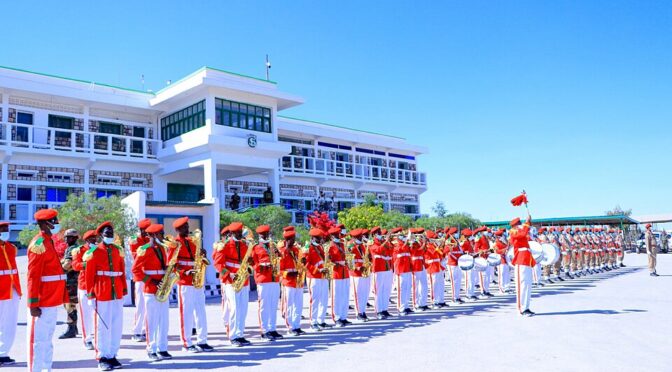
Featured image: The commemoration of the 27th Anniversary of the establishment of the Somaliland National Army. (Wikimedia Commons)