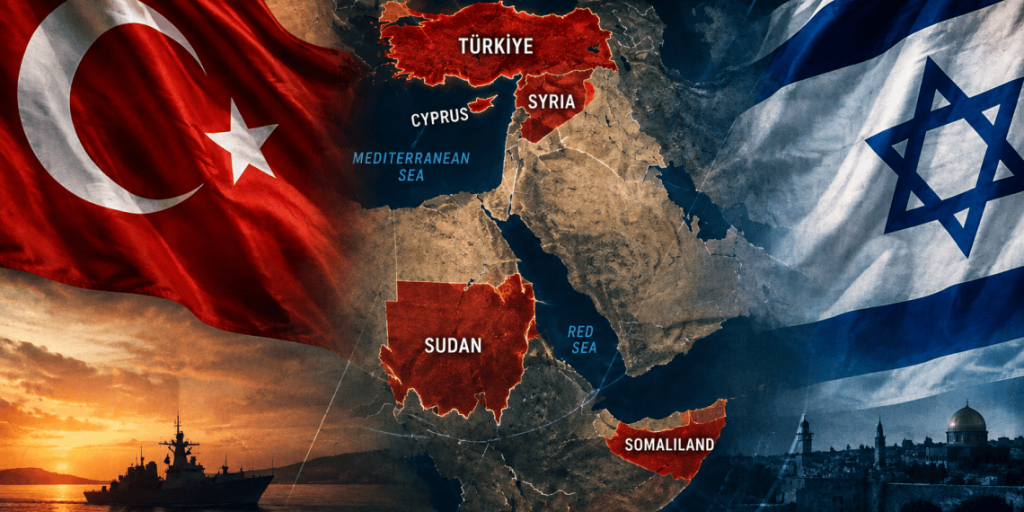
A new report by Turkey’s National Intelligence Academy (MİA) accuses Israel of pursuing a regional strategy aimed at containing Turkish influence, exploiting ethnic divisions and preventing Ankara from consolidating its security partnerships across the Middle East and Africa, warning that the rivalry now extends from Syria to Somalia, Sudan and the eastern Mediterranean.
The 82-page report, titled “Anatomy of Israeli Expansionism” and published on October 23, 2026, portrays Israel’s regional policies as a direct challenge to Turkey’s strategic interests. It argues that Israel seeks to maintain its ability to intervene in neighboring countries by limiting their military capabilities and preventing the emergence of strong regional governments with close ties to Ankara
The assessment, issued by an academy affiliated with Turkey’s National Intelligence Organization (MİT), goes beyond the longstanding dispute over Palestine. It describes an expanding geopolitical confrontation involving military partnerships, maritime access, ethnic tensions, economic corridors and competing security arrangements.
The report identifies Israel’s ultimate objective as pushing Turkey toward a more inward-looking geopolitical position, forcing Ankara to concentrate on domestic security rather than projecting influence across its surrounding regions. It presents Israeli diplomatic and military initiatives in the eastern Mediterranean, the Red Sea and the Horn of Africa as interconnected elements of that strategy.
Syria occupies a central position in the assessment. The academy argues that Israel increasingly treats efforts to prevent the rebuilding of Syria’s military capabilities and attempts to restrict Turkey’s strategic partnership with Damascus as parts of the same objective.
Turkey favors rebuilding Syria’s central authority, preserving its territorial integrity and strengthening institutions capable of maintaining security. Israel, by contrast, is portrayed as seeking to restrict the military capacity of neighboring states to preserve its ability to conduct operations beyond its borders.
The academy warns that continued Israeli military activity in Gaza, Lebanon and Syria could create a permanent zone of intervention. Such an outcome would leave neighboring governments vulnerable to repeated military operations and weaken their ability to exercise sovereign authority.
Rather than responding separately to every Israeli military move, the report recommends that Turkey strengthen regional governments and support a security structure that limits opportunities for outside intervention. It identifies the restoration of Syrian state institutions and the preservation of Palestinian sovereignty as essential components of that approach.

The report also links Israel’s regional strategy to Turkey’s renewed peace process with the outlawed Kurdistan Workers’ Party (PKK), which has waged an armed insurgency against Turkey since 1984 in a conflict that has killed more than 40,000 people. The initiative, called “Terrorism Free Turkey” by the government of President Recep Tayyip Erdogan, seeks to end the decades-long conflict through the PKK’s laying down of arms and dissolution. The academy portrays the process as a potential obstacle to Israel’s efforts to exploit ethnic and political divisions across Turkey, Iraq and Syria.
It argues that Israel benefits from environments where weak central governments and identity-based tensions create opportunities for outside intervention. As an example, it cites Israel’s use of concerns about the security of Syria’s Druze population and developments in Suwayda to justify involvement in matters affecting Damascus’ authority in southern Syria.
A successful Turkish peace initiative could weaken the role of armed organizations in relations between Ankara and Kurdish communities in neighboring countries, the report says. It could also strengthen political, economic and social ties among Turkish, Kurdish and Arab populations, reducing opportunities for foreign governments to use ethnic divisions as instruments of influence.
The academy does not cite a specific Israeli statement opposing the Turkish initiative. Instead, it frames the process as strategically consequential because greater social integration and reduced reliance on armed groups would narrow the openings for intervention that it attributes to Israeli regional policy.
The implications extend beyond Turkey’s borders. The academy argues that progress in the initiative could reduce political and social divisions across Iraq, Syria and Iran while limiting the ability of armed organizations to act as intermediaries between Turkey and Kurdish communities. It treats closer Turkish, Kurdish and Arab relations as a form of regional resilience against Israeli expansionism.
The report devotes particular attention to Somalia, identifying the country as one of the clearest examples of the expanding confrontation between Turkey and Israel in the Horn of Africa and the Red Sea.
Israel became the first country to formally recognize Somaliland, which declared independence from Somalia in 1991, as an independent and sovereign state on December 26, 2025. Diplomatic ties subsequently expanded, with Somaliland President Abdirahman Mohamed Abdullahi making an official visit to Israel in June 2026 and opening an embassy in Jerusalem on June 15.
Turkey opposed the recognition, describing it as interference in Somalia’s internal affairs and a violation of its territorial integrity. The academy places the diplomatic dispute within a wider competition involving maritime security, military cooperation and access to strategically important waterways.
Somaliland’s location near the Gulf of Aden and the Bab al Mandab Strait offers Israel additional access to maritime trade routes and the Red Sea security environment. The growing relationship is presented as part of an Israeli effort to establish a strategic presence under the framework of maritime security and freedom of navigation.
Turkey’s expanding military and security support for Somalia creates an overlapping sphere of strategic interests around the Gulf of Aden and the Red Sea. The academy warns that Israel’s recognition of Somaliland could aggravate existing instability involving the militant group al Shabab, the conflict in Yemen and the civil war in Sudan.
The document also raises the possibility that other countries could follow Israel in recognizing Somaliland, potentially creating new regional alignments and complicating efforts to resolve existing conflicts. It warns that the consequences could extend beyond the Horn of Africa to the greater Middle East.
Sudan represents another significant dimension of the rivalry. The academy states that neither Turkey nor Israel is directly involved in the Sudanese war but accuses Israel of indirectly supporting the conflict and instability through allied states.
Turkey, meanwhile, is described as providing diplomatic, economic and humanitarian assistance to Sudan’s internationally recognized government while pursuing mediation efforts. The report does not identify the Israeli allied governments allegedly involved in supporting the conflict or provide specific evidence of their activities in the section examining Turkey.
Sudan’s Red Sea coastline, ports and position within regional security networks make it an important component of Turkey’s broader strategy. The academy argues that developments in Sudan cannot be assessed separately from Somalia because both countries occupy the same strategic corridor connecting the Horn of Africa with the Red Sea.
Although the document acknowledges that Sudan has not become the scene of direct confrontation between Turkey and Israel, it describes the Sudan and Somalia corridor as an increasingly important arena where Turkish, Israeli and Gulf security interests intersect.
The geographic competition also extends to the eastern Mediterranean. Israel’s growing defense, energy and political cooperation with Greece and the Greek Cypriot administration is characterized as an attempt to encircle Turkey and restrict Ankara’s diplomatic and strategic options.

The academy puts Israel’s relationships with the United Arab Emirates and India within the same framework, arguing that broader security and connectivity networks could increase the costs of maintaining close partnerships with Turkey.
Similar concerns are raised about Israeli diplomatic, military and economic initiatives in the Balkans and the Turkic world. These activities are presented as efforts to restrict Turkey’s strategic reach and balance its influence over regional partners.
Economic infrastructure forms another part of the assessment. The India Middle East Europe Economic Corridor (IMEC), along with eastern Mediterranean energy projects and Israeli-linked logistics networks, is described as a means of establishing Israel as a major connection point among Asia, the Gulf and Europe.
The academy recommends that Turkey strengthen competing routes, particularly the Development Road linking the Gulf, Iraq and Turkey and the Middle Corridor connecting Central Asia through the Caspian region to Turkey and Europe. It argues that combining these routes could make bypassing Turkey economically less attractive.
Despite portraying Israel’s activities as a challenge to Turkish interests, the report does not advocate establishing a rival, Turkish-dominated regional order. Instead, it proposes flexible security cooperation with Gulf countries, Pakistan, Egypt and Iraq while maintaining Turkey’s existing relationships with NATO, the United States and Europe.
The central recommendation is to prevent Israeli military and technological capabilities from becoming the indispensable foundation of regional security. The academy presents stronger state institutions, reduced ethnic divisions and diversified economic and security partnerships as the principal means of limiting the regional influence it attributes to Israel.