
The year 2020 was the last that Somaliland, on the north-eastern coast of Africa, received the two rainy seasons its mixed farmers have relied on for centuries to keep living off the land.
The farmers there are agro-pastoralists that generally grow no more than one, two or three acres of crops close to their households, while grazing sheep, goats, cattle and camels on sparsely vegetated rangelands, collectively owned by their wider clan-group.
Goats and camels generally fare better at browsing sparse shrubs and bushes, as sheep and cattle prove pickier grazers that must search out grasses that manage to survive on the semi-arid landscape.
Times of intense drought, which occur with increasing frequency, see rains fall less predictably – if at all – and any rainfall that does arrive tends to come in short, intense bursts that erodes land without having sufficient time to infiltrate and feed crops or rangeland.
The intensity of recent years’ rains have eroded and degraded both rangeland and cropland, worsening a food security situation classed by humanitarian organisations as stuck at “crisis” level
More than one in 10 of Somaliland’s inhabitants are malnourished and a significant chunk of the population is scraping by cashing in livestock or farm tools for food.
The cloud of the severe drought and subsequent famine that gripped the Horn of Africa in 2011 costing 250,000 lives lingers in recent memory.
However, farmers in Somaliland are adapting to cope with the new normal of two previously predictable rains that have become one erratic downpour.
Communities there now face the relentless struggle of safeguarding their livelihood – the soil – from washing away.
Concern Worldwide is one the development organisations on the ground assisting farmers with the transition to a new normal and the Irish Farmers Journal travelled to farms around Boroma in south-western Somaliland to witness what work the group is aiding on the ground.
Its work is aimed at training farmers in using local resources to improve farm productivity without creating a reliance on outside inputs and then leaving their programmes in local ownership after this training has been completed.
The typical farm on Somaliland’s semi-arid plains will grow the two traditional starchy grain crops of the region – sorghum and maize – to deliver the bulk of their families’ calories.
Further foods are purchased with income from the sales of livestock, milk or eggs.
Livestock is central to farming and culture in the region as they are the main indicator of status and as the sole accessible storage unit of value in an economy experiencing rapid currency devaluation.
Animals are walked out to graze on uncultivated rangelands during daylight hours before they are closed in for the nighttime in pens created by a circle of cut bushes.

Farmers must sleep out with their livestock to avoid predation from foxes and cheetahs.
In times of drought when vegetation gets scarce near to their villages, families will walk livestock further distances in search of water and grazing. Conflict does not emerge when families stay on their own wider clan’s lands, which can span vast distances.
It is not considered unusual for normally settled herders to head off on journeys of up to 150km, perhaps crossing international borders, during particularly severe droughts in search of grazing.
Families will slaughter sheep or goats for their own consumption during religious festivals or for occasions like weddings, with each household milking a cow or two, sheep, goats or camels milked for domestic use and to generate sales.
Livestock sales are focussed around Islamic religious festivals when Gulf states, such as Saudi Arabia, drive huge demand for live exports from the north-east of Africa. Finished lambs and hoggets sell live €90-135/head, while off-season sales will struggle to fetch more than €55.
Camels are far more valuable in both milk and meat terms, although far fewer families can afford them compared to cattle, sheep or goats.

Flock and herd sizes vary widely, with a typical family owning between five and 10-head of cattle, along with 20 to 40-head of sheep and the same number of goats.
Land is not bought or sold in Somaliland – families plough and graze the same clan-owned lands their families have worked before them.
Tractors or any other form of mechanisation are also very rare in the region, with donkeys, camels and oxen providing the draught power on farms.
“We were planning to leave. We had to buy food from the market as our planting area was getting smaller and the erosion was expanding at very quick rate,” Ahmed, a farmer in his 40s, explained.
A growing chasm running 2m deep along 3km through farmland was what Ahmed had faced until 2023, when Concern Worldwide reached out to the community to solve the erosion issue.
However, the picture the farmer painted sits in stark contrast to the current scenery, where a green oasis sticks against the wider degraded and heavily eroded landscape.

Ahmed’s farm was, until recently, heavily degraded too, to an extent that it was even worse than many others not far from his as a large gash had been cut into the soil by years of flash floods increasingly funnelled into a single gulley.
This gulley formed the path of least resistance for rains desperately needed by crops and rangeland that picked up topsoil every time it sped off his lands and those of the 3,300 locals dependent on adjoining the farmland as it washed downhill.
Concern Worldwide consulted with the community which flagged this widespread and large erosion as the biggest issue facing families, with 50 arable farms at immediate risk of being washed away.
The solution lay largely with the power of the heavy flash floods that eroded the land in the first place: leaking stone dams could be laid inside the gulley awaiting the next soil-laden flood waters. The flow would then slow allowing the carried soil to settle behind the dams, filling in the deep crack with each significant rain that falls.
As the gulley fills out, rainfall is spread over a wider area of rangeland and cropland to soak in and replenish vegetation, the vegetation itself acting to slow water and increase infiltration as it becomes established.
Just as the degradation would have continually worsened if left unchecked, the restoration follows a positive feedback loop as each improvement accelerates the next.
Installing these dams required rock to be drawn from a nearby mountain into a truck that took it to the gulley’s bank in the only step of the process that was mechanised.
Locals then filled the rock into the steel-meshed gabions across the entirety of the gulley’s 3km-length, with the overall quantity of rock required entering tens of thousands of tonnes.

The cost of labour was made up of a mix of community contributions and a ‘cash for work’ scheme that employed locals.
“Each year, the land is getting greener.
“We are no longer spending money on food, we have access to enough of our own and we can sell the surplus,” Ahmed said standing in grass up to his shins.
The farmer reports that surprise, shock and then curiosity are the main reactions witnessed in visitors who see the restored area for the first time – visitors keen to learn from Ahmed’s community and roll out restoration measures on their own lands.
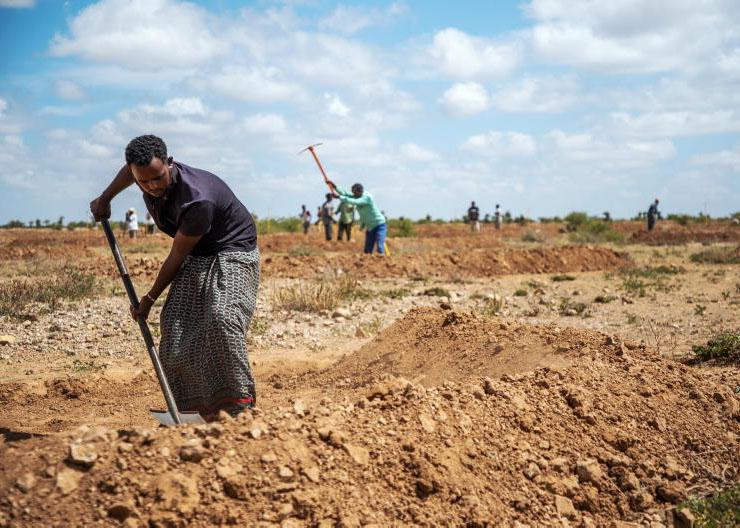
There are over 2,700 crescents dug and scattered evenly across 60ha of rangeland on which 70 households graze their livestock in a village in the south-west of Somaliland.
The locals dug the semi-circular soil banks by hand in 2025 in a bid to create small catchment-areas for rainfall to pool during flash floods.
The hollows catch rains, allow them to soak into the rangeland and prevent the erosion caused by floods running over the land without infiltrating it.
The small structures are governed by a set of bye-laws drawn up by a local management committee and agreed to by the elders that sets out when the lands can be grazed and when they must be maintained. Shrubs, grasses and trees will initially sprout inside the half-moons where the most water pools, before spreading out and filling in the gaps between each crescent.
“We are seeing this happen live with out own eyes,” Farah, one of the farmers who dug the half-moon structures said.
“The vegetation is coming back and we can see tall trees even though the rain seasons have not come as well as expected.”
The 50-year-old farmer remarks that he had been living next to the rangeland for his whole life and had never seen trees rise above the soil.