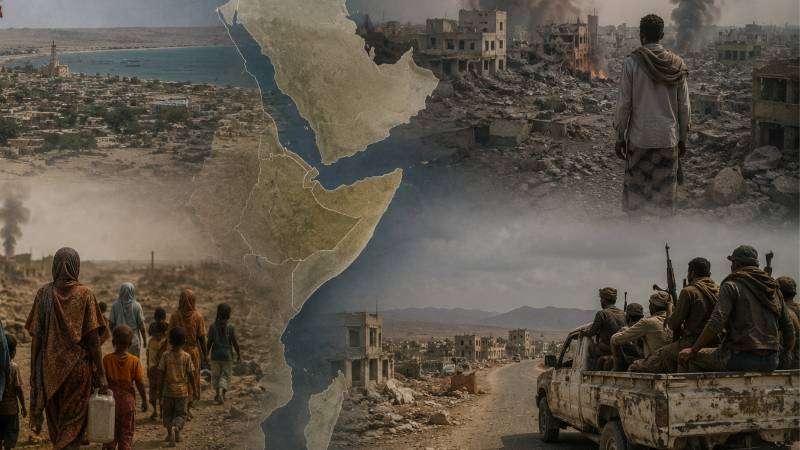
Look at the map from the Horn of Africa across the Red Sea to Yemen and a pattern becomes difficult to ignore. Political questions that were never properly settled are now being drawn into a much wider regional contest. Saudi Arabia, the United Arab Emirates, Iran, Egypt, Türkiye and other states all have legitimate interests.They are concerned about shipping routes, ports, security, trade and political influence. This is normal in international relations. The trouble begins when already fragile countries become places where those interests are pursued through competing governments, military partnerships and armed groups.
Somaliland is a case in point. Its political history did not begin in 1991. The former British Somaliland Protectorate became independent on 26 June 1960 and received recognition or formal messages of welcome from more than thirty governments. On 1 July 1960 it entered a voluntary union with the former Italian-administered Somalia. That distinction matters because Somaliland does not view itself as a new separatist project from Somalia, but as a previously independent state that withdrew from a failed union (Here example of Czechoslovakia can be relatable to some extent).
When Siad Barre’s regime collapsed in 1991 and Somalia entered into a more deadly unrest, Somaliland restored its sovereignty. It has since spent thirty-five years functioning as a de facto state. Under Muhammad Haji Ibrahim Egal, it moved from conflict towards reconciliation and institution-building. From that period to the present administration of Abdirahman Mohamed Abdullahi Irro, Somaliland has maintained its own government, elections, currency and security institutions.
Somaliland is not without problems. Political divisions, clan grievances and the conflict in its eastern regions cannot be ignored. Still, its experience differs considerably from Somalia’s struggle since the fall of Barre. Somalia has rebuilt a federal government and received extensive international support till the day today from UN, AU and others, but it continues to face al-Shabaab, weak institutions, corruption and recurring disputes with Puntland and Jubaland. Unlike Somaliland, both Puntland and Jubaland were historically part of Italian Somalia before independence. Yet repeated disagreements of Bosaso and Kismayo with Mogadishu reveal that Somalia’s own internal unity remains unfinished.
What appears to be an abstract argument over sovereignty eventually affects a student seeking admission abroad, a trader receiving an international payment or a patient travelling for treatment.
And this is where regional geopolitics enters…
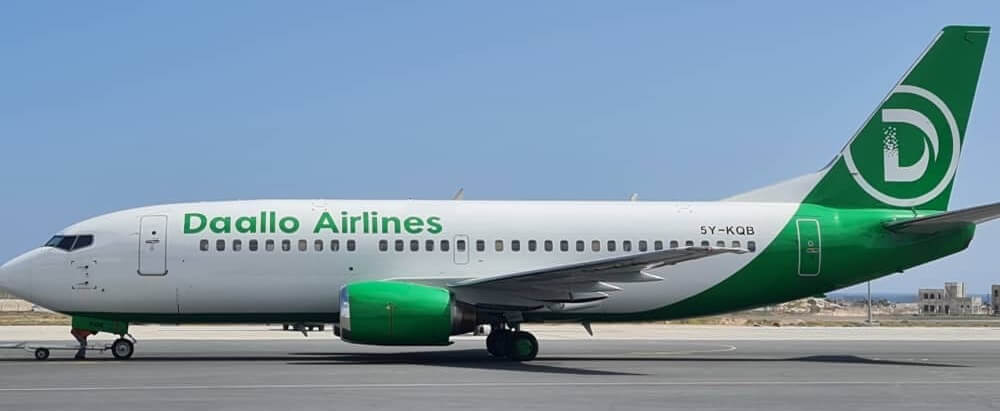
The UAE’s engagement with Somaliland, particularly through DP World’s investment in Berbera Port, has brought visible economic value. Berbera is creating infrastructure, trade links and employment while giving Somaliland a route towards the Ethiopian market. DP World has committed up to $442 million to the port, with expansion plans designed to increase its capacity substantially.
It would be unfair to describe this investment merely as foreign interference. Somaliland needed infrastructure, and the UAE was willing to invest where most of the international community would not. Yet Berbera also sits close to Bab el-Mandeb, one of the world’s most important maritime passages. It is therefore both an economic project and a strategic asset. The two realities are not mutually exclusive.
Saudi Arabia, meanwhile, has maintained close relations with Somalia’s internationally recognised federal government and signed a military cooperation agreement with Mogadishu in February 2026. This should not automatically be presented as an agreement against Somaliland. Riyadh has its own concerns regarding Red Sea security, sovereignty and regional order.
Israel’s recognition of Somaliland in December 2025 brought Hargeisa back into Global headlines. But the issue is larger than Israel. Several Muslim-majority countries already maintain relations with Tel Aviv. The harder question is whether Somaliland will be judged on its history, institutions and political record, or only when its strategic location becomes useful to another country.
For people, these diplomatic calculations have practical consequences and they hear, read what media wants them to know or think about. Somalia has international recognition but still struggles with insecurity, poverty and limited opportunities. Somaliland has achieved relative stability, yet non-recognition restricts its access to international banking, insurance, investment and travel. Somalilanders have their own passport, but many still rely on Somali documents because they are more widely accepted internationally. What appears to be an abstract argument over sovereignty eventually affects a student seeking admission abroad, a trader receiving an international payment or a patient travelling for treatment.
Sudan represents the more violent side of the same regional struggle. The war between the Sudanese Armed Forces and the Rapid Support Forces began with Sudan’s own failed political transition. It cannot simply be blamed on outsiders. Yet foreign involvement has made the conflict harder to end. The UAE has been accused by UN researchers, American lawmakers and the Sudanese military of supporting the RSF in the country which Abu Dhabi denies. On the other side Egypt, Saudi Arabia, Türkiye, Pakistan and Qatar etc. have been closer to the Sudanese army to varying degrees. Meanwhile, Sudanese civilians have faced displacement, hunger and the destruction of entire cities.
For regional actors, Sudan may represent Red Sea access, agricultural land, gold and strategic influence. For a Sudanese family, it is simply home. Whatever political advantage an outside power obtains, the cost borne by the Sudanese population is far greater. On the other side, Yemen is no longer governed as one political space. The Houthis control Sana’a and much of the northwest. The internationally recognised authorities have mainly relied on Saudi support in the East, while the Southern Transitional Council has pursued the restoration of South Yemen with backing from the UAE.
The STC’s advances and subsequent setbacks in early 2026 exposed differences between Saudi and Emirati approaches, even though the two countries originally intervened as partners. Yemen cannot, however, be understood only through the language of proxies. The Houthi question is real, the southern demand for statehood is real, and the internationally recognised government’s claim is also real. Ignoring any one of them will only delay the next confrontation.
Yemen was once associated with Aden, Sana’a, Socotra, commerce and tourism. Today, millions live between rival authorities, damaged institutions and severe restrictions on movement and opportunity. Neither Saudi Arabia nor the UAE created all these crises. Both have invested, mediated and provided humanitarian assistance. Local leaders also seek external backing and frequently use it against domestic rivals. Responsibility is shared.
But influence must come with restraint. Somaliland and Somalia need direct dialogue based on history and present realities. Sudan needs an end to the foreign support sustaining its war and a return to civilian politics. Yemen needs negotiations that take its northern, southern and internationally recognised authorities seriously. Regional powers will continue pursuing their interests; that is the nature of international relations. The real test is whether they can do so without turning entire societies into strategic playgrounds. Ports and coastlines may look like assets on a map, but they are also people’s homes. When dialogue is delayed and rivalry takes priority, it is always the local population that pays the bill.