

The Mecca Pact and Somaliland’s Rising Geopolitical Value
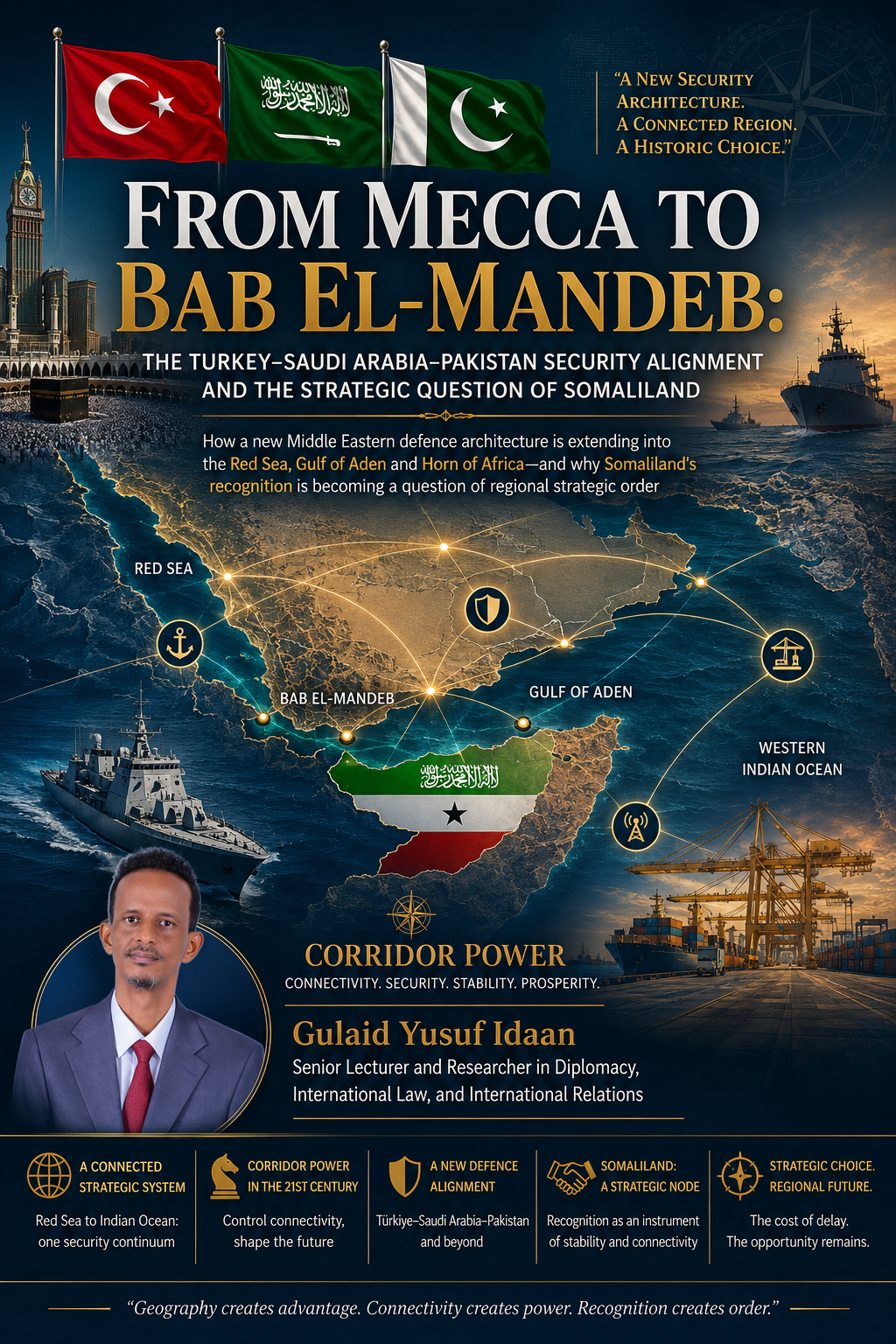
From Gulf Security to Horn Strategy: The Mecca Pact and Somaliland’s Rising Geopolitical Value
The Saudi Arabia–Türkiye–Pakistan defense pact is reshaping the strategic map from the Gulf to the Horn of Africa. For Israel, India, the UAE and the United States, Somaliland is becoming increasingly difficult to ignore.
The signing of the Saudi Arabia–Türkiye–Pakistan Joint Defense Agreement in Mecca on 7 August 2026 should not be viewed simply as another bilateral or regional defense arrangement.
Its significance lies in the geography surrounding it.
The three countries are creating a new institutional framework for security cooperation at a moment when the Middle East is undergoing a major strategic transformation. The agreement’s collective-defense principle—under which an armed attack against one participant is treated as an attack against all three—gives the relationship a degree of strategic weight that goes beyond their existing bilateral ties.
Turkish officials have emphasized that the agreement is defensive and is not directed against a particular country. It would therefore be premature to describe it as a formal anti-Iran or anti-Israel alliance.
But the agreement nevertheless matters because it institutionalizes a convergence among three states whose strategic interests increasingly intersect across the Middle East, Arabian Sea and Indian Ocean.
And that convergence does not stop at the Red Sea.
It reaches toward the Gulf of Aden, Bab el-Mandeb and the Horn of Africa.
That is where Somaliland enters the equation.
A security system is emerging from the Gulf to the Horn
The traditional division between Middle Eastern politics and Horn of Africa geopolitics is becoming increasingly difficult to sustain.
The Persian Gulf, Arabian Sea, Gulf of Aden, Bab el-Mandeb, Red Sea and Suez Canal are not independent strategic theaters. They form an interconnected maritime system through which energy, trade, military deployments and geopolitical influence move.
A disruption in the Red Sea affects the Suez Canal.
Instability around Yemen affects shipping entering the Gulf of Aden.
Security developments in Saudi Arabia influence calculations along the Red Sea coast.
Military cooperation between Türkiye and Somalia affects the western side of the Gulf of Aden.
Port investments in Berbera connect the Gulf with the Horn.
And the strategic interests of India, Israel, the UAE, Ethiopia and the United States increasingly intersect across the same geography.
The Mecca agreement should therefore be interpreted as part of this wider process.
Its importance is not simply that Saudi Arabia, Türkiye and Pakistan have signed a defense pact.
Its importance is that a new regional security network is becoming more institutionalized at precisely the moment when maritime competition around the Red Sea is intensifying.
The strategic question is consequently no longer confined to who controls the Gulf or who influences Yemen.
It increasingly concerns who can shape the wider network connecting the Middle East, the Red Sea, the Horn of Africa and the western Indian Ocean.
Türkiye’s Horn strategy gives the agreement an African dimension
Türkiye is particularly important in this equation because it already possesses a significant strategic presence on the African side of the Gulf of Aden.
Ankara‘s relationship with Somalia has developed into one of its most important security and political partnerships in Africa. Turkish military training, defense cooperation and political engagement have given Ankara substantial influence in Mogadishu.
This matters because Türkiye is not approaching the Horn from a distance. It already has strategic depth there. The Mecca agreement therefore gives an existing Turkish regional presence a broader geopolitical context. Türkiye’s relationship with Somalia is also relevant to Somaliland.
Ankara has traditionally supported Somalia’s territorial-integrity position and has opposed moves that could lead to Somaliland’s international recognition. This creates a strategic contrast between two emerging poles on the western side of the Gulf of Aden. One is centered on Mogadishu and Türkiye.
The other is increasingly centered on Hargeisa, Berbera and the networks connecting Somaliland with Ethiopia, the UAE, Israel and potentially India. This does not mean that these two systems must inevitably become military rivals. But it does mean that the strategic geography of the Horn is becoming more competitive.
Berbera is changing Somaliland’s strategic value
The most important element of Somaliland’s strategic position is not recognition alone.
It is Berbera.
The development of Berbera Port and the Berbera–Ethiopia corridor has transformed Somaliland’s geographical position into a functioning logistical asset.
This is what can be understood as Corridor Power: the ability of a strategically located territory to increase its geopolitical importance by connecting ports, infrastructure, trade routes, economic hinterlands and security networks.
Somaliland possesses several components of this power simultaneously. Its coastline places it on the Gulf of Aden. Berbera converts that geography into port and logistical capacity. The corridor toward Ethiopia connects the coast to one of Africa’s largest landlocked economies. And its expanding relations with Israel, the UAE and Ethiopia give the port a diplomatic and strategic dimension.
These relationships reinforce one another. The port creates economic value. The corridor creates continental relevance. Economic relevance generates external interests. External interests create security considerations. Security considerations increase diplomatic engagement. And diplomatic engagement can eventually influence recognition.
That is why Somaliland should not be viewed simply through the conventional question of whether it is recognized as a sovereign state. Its strategic importance is increasingly being produced by connectivity.
Israel’s recognition changed the calculation
Israel’s recognition of Somaliland on 26 December 2025 fundamentally changed the diplomatic environment surrounding the territory.
Before recognition, Somaliland’s international status could largely be treated as a frozen diplomatic question. After recognition, it became a strategic question with an established precedent.
Recognition did not automatically produce international consensus. Somalia continues to reject Somaliland’s independence, and many states remain cautious about changing the regional status quo. But Israel’s decision demonstrated that a major external power was prepared to connect Somaliland’s diplomatic status with its own strategic interests.
For Israel, geography is difficult to ignore.
Somaliland lies on the southern side of the Gulf of Aden, close to the maritime system leading toward Bab el-Mandeb and the Red Sea. For a country whose security and commercial interests are directly affected by instability in the Red Sea, developments on the opposite side of the maritime corridor matter.
The significance of Somaliland for Israel therefore goes beyond diplomatic symbolism.
It potentially concerns maritime security, intelligence, early warning, commercial shipping and the wider security environment surrounding the southern Red Sea.
Israel’s recognition should consequently be understood as more than a bilateral diplomatic decision.
It can also be interpreted as an attempt to establish a political relationship with a strategically positioned actor at a critical point in the emerging Red Sea security architecture.
The UAE and Ethiopia provide the economic bridge
The UAE is central to this transformation because Abu Dhabi‘s relationship with Somaliland has been built around ports, logistics and commercial infrastructure.
Berbera is particularly important because it links maritime access to a continental market.
That market is Ethiopia.
For Addis Ababa, maritime diversification is a strategic necessity. Ethiopia’s dependence on Djibouti for most of its maritime trade creates a concentration of logistical vulnerability. The Berbera corridor provides another potential route.
This does not mean Ethiopia will abandon Djibouti. The more rational strategy is diversification.
For Ethiopia, multiple maritime options mean greater resilience and greater bargaining power. For Somaliland, Ethiopia provides something equally important: economic depth. A port without a hinterland has limited strategic value. A port connected to a major continental economy is considerably more important.
This is why Berbera should be understood not as an isolated port but as part of a larger maritime–continental corridor.
The UAE’s investment, Ethiopia’s maritime requirements and Somaliland’s geographical position therefore reinforce one another.
The result is a strategic network that exists independently of whether all participating states agree on Somaliland’s final political status.
India cannot ignore the western Indian Ocean
The Mecca agreement also introduces a major Indian dimension. Pakistan’s participation means that the new security arrangement is no longer purely Middle Eastern.
It extends into the strategic environment of the Arabian Sea and western Indian Ocean.
For India, this is significant.
New Delhi‘s interests extend westward from the Arabian Sea through the Gulf of Aden and Red Sea toward the Suez Canal and Mediterranean. The security of these maritime routes is directly connected to India’s energy supplies and trade.
The emergence of a stronger Saudi–Türkiye–Pakistan security relationship therefore creates an additional incentive for India to examine the strategic geography of the southern Red Sea.
Somaliland offers India something distinctive.
It sits close to the Gulf of Aden and provides a potential platform for maritime cooperation without requiring India to immediately transform its relationship with Somaliland into a military alliance.
Maritime-domain awareness, port cooperation, commercial investment, coast-guard cooperation, anti-piracy efforts and diplomatic engagement could all deepen India’s presence.
Recognition is ultimately a political decision. But strategic engagement does not have to wait for recognition. This distinction is increasingly important.
The emerging strategic network
The significance of Somaliland becomes clearest when these relationships are viewed together.
The emerging network can be understood through several connected corridors.
The maritime corridor runs through the Gulf of Aden and Bab el-Mandeb toward the Red Sea and Suez.
The continental corridor connects Berbera to Ethiopia.
The commercial corridor links Berbera with UAE investment and global logistics.
The diplomatic corridor connects Somaliland with Israel, the UAE and Ethiopia, with India potentially becoming an additional node.
And the security corridor is developing through growing concern over maritime threats, intelligence, surveillance and the protection of commercial shipping. These corridors do not constitute a formal alliance. That is precisely why they are important.
Modern geopolitical competition does not always take the form of formal military blocs. Influence can be accumulated through ports, infrastructure, logistics, trade, technology, intelligence, diplomatic recognition and strategic partnerships. The power of a network comes from the connections between its nodes. Somaliland’s importance therefore derives not simply from what it is, but from what it connects.
The United States faces a strategic choice
Washington must also reconsider whether Somaliland can continue to be treated primarily through the lens of Somalia policy.
The regional environment has changed.
The United States now faces an increasingly complex strategic environment involving Iran, the Houthis, Saudi Arabia, Türkiye, Pakistan, Israel, India, the UAE, Ethiopia and China.
The Red Sea has become an important arena of strategic competition. In this environment, Somaliland’s geographical position deserves greater attention. This does not necessarily mean that Washington must immediately recognize Somaliland.
A more immediate question is whether the United States should develop a comprehensive strategy toward Berbera, maritime security and Somaliland’s role in the western Indian Ocean.
The danger of strategic delay is that infrastructure, commercial interests and security partnerships can become entrenched. Once a regional network becomes institutionalized, joining it becomes more expensive than participating during its formation. This is the deeper significance of the current moment.
Recognition is becoming a question of strategic architecture
The central mistake would be to treat Somaliland’s recognition as an isolated diplomatic issue. It is becoming part of a much larger strategic question.
Who will shape the security architecture of the southern Red Sea?
Who will influence the maritime routes connecting the Gulf of Aden to the Suez Canal?
Who will provide alternative logistical corridors for Ethiopia?
Who will establish relationships with the coastal territories surrounding Bab el-Mandeb?
And who will shape the political networks connecting the Middle East, Africa and the Indian Ocean?
These questions are now increasingly connected.
The Mecca agreement demonstrates that Saudi Arabia, Türkiye and Pakistan are attempting to create stronger regional security capacity.
Israel’s recognition of Somaliland demonstrates that diplomatic recognition can also become a strategic instrument.
The UAE’s role in Berbera demonstrates how infrastructure can create long-term geopolitical influence.
Ethiopia’s interest in the Berbera corridor demonstrates how economic necessity can reshape regional partnerships.
India’s western maritime interests demonstrate that the Red Sea is no longer merely a Middle Eastern concern.
Together, these developments point toward a broader transformation.
From geography to strategic power
Somaliland’s greatest asset is its geography. But geography alone does not produce geopolitical power.
Geography becomes power when it is connected to infrastructure. Infrastructure becomes strategic when it is connected to economic corridors. Economic corridors become politically significant when external powers develop interests in their protection. And those interests can eventually produce diplomatic commitments.
This is the process now unfolding around Berbera.
Somaliland is moving from being geographically significant to becoming increasingly network significant.
That distinction matters.
A geographically important territory can be ignored.
A territory embedded in multiple strategic networks becomes much harder to ignore.
This is why the Mecca agreement matters to Somaliland even though Somaliland is not a party to it.
The agreement strengthens the institutionalization of one regional security network.
At the same time, other networks are developing around the southern Red Sea, involving Israel, the UAE, Ethiopia and potentially India and the United States.
Somaliland sits at the intersection.
The strategic choice ahead
The emerging regional order will not necessarily be defined by one dominant alliance.
It may instead be defined by competing and overlapping networks.
Saudi Arabia, Türkiye and Pakistan are building one institutional security framework.
Israel, the UAE, Ethiopia and potentially India have interests that could support another set of strategic connections.
The United States remains capable of influencing both.
Somaliland occupies a particularly sensitive position between these systems.
Its challenge is to convert geographical importance into durable political, economic and security partnerships without becoming trapped in the rivalries of larger powers.
For Israel and its partners, the challenge is different.
They must decide whether Somaliland is merely a diplomatic partner or whether it should be understood as part of the strategic depth of the southern Red Sea.
For India, the question is whether western Indian Ocean strategy should extend more deliberately toward the Gulf of Aden.
For the UAE, the question is how to protect and expand the strategic value of Berbera as regional security competition intensifies.
For Ethiopia, the question is how to secure diversified maritime access without turning commercial connectivity into unnecessary geopolitical confrontation.
And for the United States, the question is whether strategic ambiguity remains useful—or whether it is becoming an opportunity cost.
A new map is emerging
The most important lesson of the Mecca agreement is therefore not that Saudi Arabia, Türkiye and Pakistan have created another military bloc.
It is that regional security architecture is becoming increasingly interconnected across the boundaries of the Middle East, Africa and South Asia.
The Gulf cannot be separated from the Arabian Sea.
The Arabian Sea cannot be separated from the Gulf of Aden.
The Gulf of Aden cannot be separated from Bab el-Mandeb.
Bab el-Mandeb cannot be separated from the Red Sea.
And the Red Sea cannot be separated from Suez and the Mediterranean.
Once this geography is understood as one strategic system, Somaliland’s importance becomes clear.
Berbera is not simply a port. It is a potential node connecting the Gulf of Aden, Ethiopia, the Red Sea and the wider Indian Ocean.
Israel’s recognition has given that node a diplomatic dimension.
The UAE has given it an economic and logistical dimension.
Ethiopia has given it continental relevance.
And the emerging Saudi–Türkiye–Pakistan security alignment gives the wider region a new strategic context.
The question is therefore no longer simply whether Somaliland will receive more international recognition.
The more consequential question is who will shape the regional architecture that is forming around Somaliland.
That is the real geopolitical significance of the journey from Mecca to Bab el-Mandeb.
And it is why Somaliland is becoming not merely a question of sovereignty—but a question of regional strategy.