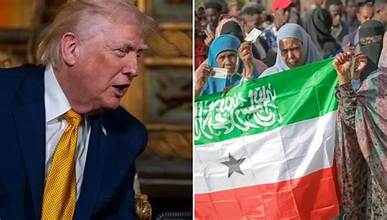
U.S. President Donald Trump has described Somalia and Somaliland as “totally different” countries and suggested that Somaliland should immediately change its name, adding a new twist to the politically sensitive question of whether the self-governing territory should become internationally recognized as an independent state.
“I call it Somalia land, not Somaliland, because actually it’s a totally different country. Some people like Somaliland. It has nothing to do, you know that, has nothing to do. I said, you got to be kidding. I think they should change the name immediately,” Trump said in remarks referring to the distinction between Somalia and Somaliland.
The comments have attracted attention amid a renewed campaign by Somaliland’s leadership to secure U.S. recognition, following Israel’s decision in December 2025 to become the first United Nations member state to formally recognize the territory as independent. However, Trump’s comments should not be interpreted as a formal change in U.S. policy. Washington has continued to support Somalia’s territorial integrity, and the administration has not announced recognition of Somaliland.
A separate colonial history
Somaliland’s independence claim is rooted in a distinct colonial history. The territory was administered as a British protectorate, while southern Somalia was under Italian administration.
British Somaliland became independent on June 26, 1960. Five days later, on July 1, it united with the former Italian-administered territory to establish the Somali Republic.
The union was driven partly by pan-Somali nationalism and the desire to unite Somali-speaking populations after colonial rule. However, the political arrangement subsequently became a source of grievance among some northern communities, who argued that they were marginalized within the new state.
Following the collapse of President Mohamed Siad Barre’s military government in 1991, Somaliland’s leaders declared the restoration of independence. Since then, the territory has operated with its own government, security forces, currency and institutions, while seeking international recognition.
Its supporters argue that the claim is not simply an attempt to create a new state by breaking away from an existing country. Rather, they maintain that Somaliland is seeking recognition of its earlier independence and the failure of the 1960 union to deliver the political settlement they expected.
That historical argument is central to Somaliland’s diplomatic campaign, although Somalia rejects separation and maintains that the territory remains part of its sovereign territory.
Genocide allegations remain central to the independence argument
The legacy of violence under Siad Barre’s government is another major element of Somaliland’s case for independence.
During the late 1980s, government forces launched a brutal counterinsurgency campaign against the Somali National Movement, an armed opposition group with a strong base among the Isaaq clan in the north.
Human Rights Watch documented widespread killings of civilians, arbitrary detention, torture, the destruction of settlements and livestock, and aerial bombardment of Hargeisa and other northern towns in 1988. The violence drove large numbers of people from their homes, including hundreds of thousands who fled into neighbouring Ethiopia.
Somaliland’s advocates describe the campaign as genocide against the Isaaq population and argue that the atrocities destroyed the political foundations of the union. Human Rights Watch’s documentation provides evidence of systematic abuses and mass civilian suffering, although the legal classification of particular crimes must be distinguished from the historical record of those abuses.
The events remain deeply significant to Somaliland’s political identity and its argument that renewed integration with Mogadishu cannot simply be assumed.
Israel breaks the diplomatic deadlock
The international debate changed on December 26, 2025, when Israel formally recognized Somaliland as an independent state.
The announcement was welcomed by Somaliland’s President Abdirahman Mohamed Abdullahi, widely known as Irro, as a major diplomatic breakthrough. Israel said the relationship would include cooperation in economic development, agriculture and other sectors, while Somaliland expressed interest in joining the Abraham Accords.
Israel’s decision, however, prompted strong opposition from Somalia and other regional governments, which argued that recognition undermined Somalia’s sovereignty and territorial integrity. The dispute also reached the United Nations Security Council, where officials warned of potential regional consequences.
The recognition has not automatically led to broader international acceptance. The United States has not followed Israel, and the African Union’s longstanding emphasis on territorial integrity remains an important obstacle to Somaliland’s campaign.
Nevertheless, Israel’s move has demonstrated that recognition is no longer merely a theoretical question. It has become a live diplomatic issue with implications for security, trade and competition around the Red Sea and Gulf of Aden.
Why Washington and other powers are interested
Somaliland’s campaign is increasingly framed around strategic and commercial interests, as well as historical and legal arguments.
Its location along the Gulf of Aden, near the Bab el-Mandeb maritime corridor linking the Red Sea with the Indian Ocean, gives it potential importance for shipping security, military logistics and regional trade.
Berbera, its principal port, has attracted attention as a possible gateway for investment and as an alternative maritime outlet for parts of the Horn of Africa. Somaliland’s leadership has also promoted access to minerals, infrastructure and other commercial opportunities in its efforts to win international support.
In September 2026, Semafor reported that President Irro was offering Washington opportunities involving the port, mineral resources and potentially expanded military access in exchange for recognition. Irro said such arrangements would involve reciprocal benefits, while leaving the possibility of future military access open to negotiation.
That offer reflects Somaliland’s effort to make recognition relevant to U.S. strategic priorities. It does not mean Washington has agreed to establish a military base or recognize the territory.
The United Arab Emirates has also developed significant commercial interests in Berbera, while Somaliland maintains relations with Taiwan, another relationship that intersects with broader geopolitical competition involving China.
Ethiopia, meanwhile, has an important economic interest in gaining reliable access to the sea. Its January 2024 memorandum of understanding with Somaliland, which raised the prospect of maritime access and a possible path toward recognition, triggered a major dispute with Somalia. The two countries subsequently signed the Ankara Declaration in December 2024, committing to pursue arrangements for Ethiopia’s access to the sea under Somalia’s sovereign authority.
These interests do not establish that Western governments collectively intend to recognize Somaliland. They do, however, show why the territory’s status has become increasingly connected to the strategic calculations of governments beyond the Horn of Africa.
Trump’s position remains uncertain
Trump’s latest remarks come amid renewed attention to Somaliland’s recognition campaign. In August 2025, he said his administration was looking into the question, but after Israel’s recognition later that year, he indicated that Washington would not immediately follow suit.
On October 12, 2026, Somaliland’s president again appealed directly to Trump, describing him as a leader who could make history by recognizing the territory, according to an interview published by Breitbart News.
The combination of Trump’s latest comments and Somaliland’s lobbying illustrates the uncertainty surrounding the U.S. position. His description of the two territories as different countries may be read as an acknowledgment of their distinct political realities, but it does not itself constitute diplomatic recognition.
The wider dispute remains a clash between two principles: Somaliland’s argument for self-determination, based on its colonial history, separate institutions and experience of mass violence, and Somalia’s claim to territorial integrity, backed by the prevailing international position.
For Somaliland, the immediate challenge is to convert its long-standing de facto autonomy and Israel’s recognition into broader diplomatic acceptance. For Somalia, the priority is to prevent further international recognition from weakening its territorial claims.
Trump’s comments have added visibility to that debate, but whether the United States changes its position will depend on a formal policy decision rather than the president’s choice of words.SECO