From the Red Sea to the Strait of Hormuz, economic interests are driving a new contest for global influence
Currently, the world has 65 active conflicts, which is the highest number post WWII. Out of these nine are interstate and the remaining 57 are intra state. However, the most significant one that affects the whole world is the Iran-US war. Though scaled down in intensity after the Pakistan-brokered ceasefire and the Islamabad MoU, it still impacts the world economy the most.
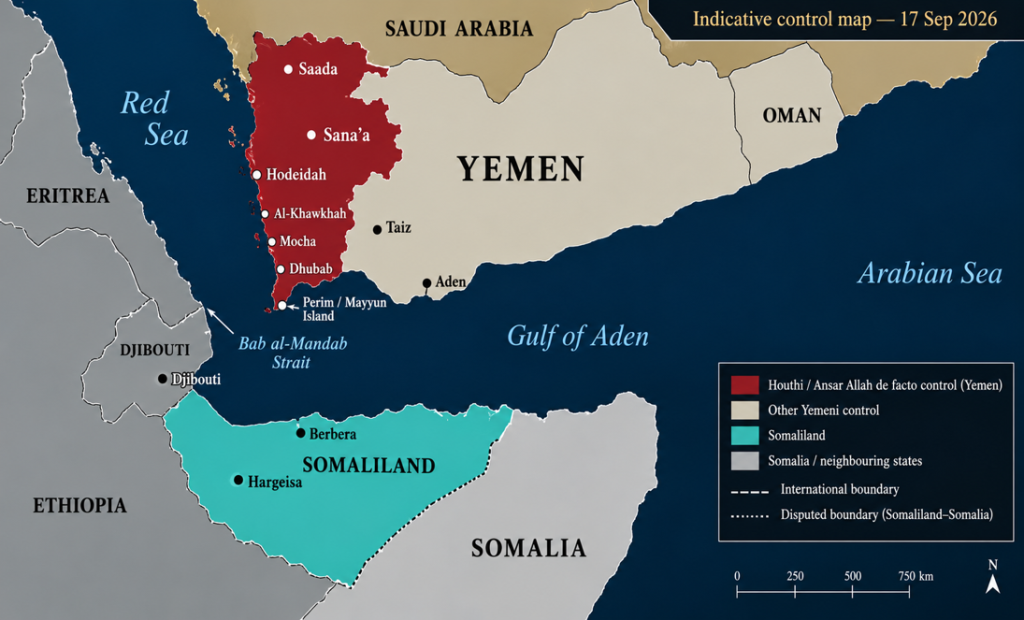
The recent unprecedented and quick sweep of Houthis capturing the southern coast of Yemen along the Red Sea has added a newer dimension to this imbroglio. To top it all, US President Trump’s denial to Crown Prince Mohammed bin Salman’s requests to conduct strikes against the Houthis, and the Houthis’ assurances of not attacking the US and Israeli vessels, came as a surprise to all, but more so for the Kingdom of Saudi Arabia, an old US ally.
Connecting these developments to Somaliland and its recognition by Israel in December 2025, and UAE’s reported intent to establish a military base there make it a complex maze of geo-strategy. Is it a complementary effort by Iran to counter the alternative oil supply route of KSA? Or is it a US-Israel tit-for-tat endeavour to pressurise KSA to join the Abraham Accords? Nonetheless, it implies that the Bab al-Mandeb and Red Sea maritime route can be controlled any time by the Houthis and Somaliland, albeit with external support.
One must acknowledge that Trump has a strategic sense and vision that he is proudly implementing for the US. It was well deduced at the beginning of Iran-US-Israel War, that the whole effort centres around control of oil, critical minerals, the oceanic chokepoints, keeping petro dollars thriving, continuation of Israeli atrocities and expansion in this garb, and to carve a new security architecture in the region built around the Abraham Accords and Make America Great Again (MAGA). A hold on Venezuelan oil, planned efforts to control Latin American and African oil, and the US-Denmark-Greenland accord on Greenland, where melting ice is creating new water ways and, its possession is essential for establishing Golden Dome air defence system by US, as well as denial of access to its natural riches to Russia and China are the means to gain the ends of this strategy.
It’s only apt to emphasise here that all these conflicts are least about religion or ideology. These are primarily part of economic contestation including trade, control of resources, sea and land accesses and war economy. Interestingly, as of now, the largest oil and gas producing, and exporting country is the US. Despite war, Iran earns billions of dollars from oil sales and Russian gas passes through Ukraine and Ukraine gets royalty. The other element of the war economy is who benefits maximum from prolongation of the conflict(s) and restricted oil flows? The chief beneficiaries are oil producing countries, insurance and shipping companies, black market and military industrial complexes. Israel has been intentionally kept out of this phase of the war affording it opportunity to regroup, reequip and rebuild to continue with its expansionist policy and become strong enough to perpetuate as regional might. Systemic genocide of Palestinians, especially children persists in this moral and legal vacuum.
In this whole scenario, the shedding of responsibility by the US to oversee “the rules-based world order” as a super power engenders chaos, anarchy and increasing sense of insecurity. Consequently, the smaller and middle powers are building interest based alliances to secure their interests, and are hedging to join the blocs/camps.
China’s speedy rise through win-win economic cooperation stays the prime focus of Trump’s MAGA strategy, which boils down to imperialist expansion to enhance US sphere of influence, slow down US decline and scuttle Chinese rise. The recent meeting of President Xi and Trump at the White House may not end their contest, but could help keep it non-kinetic for now.
 The Iran-US war is likely to continue until both sides lower their truce aims. Iran is not likely to settle for less than royalty for strait of Hormuz, like Suez canal, assured cessations of hostilities, lifting of sanctions and integration into the world economic system. The Houthis may follow the lead to come to terms with Yemen and KSA in somewhat similar manner. The long term solution of the Iran-US, Houthis-Yemen-KSA and Israel’s accesses resides in diplomacy and politics, not in the use of military instruments.
Pakistan’s brokering of ceasefire, making the Islamabad MoU happen, KSA-Pakistan bilateral, and then trilateral joint defence agreement including Türkiye and continued improvement in our relations with all major and middle powers are manifestations of this fact. Pakistan must continue with efforts for longer lasting regional peace by bringing Iran-US back to table and help effect a ceasefire and forge a long-term solution of Yemen-Houthis-KSA issue. At the same time, new-found relevance and friendships are to be translated into B2B and P2P long-term partnerships to construct complex interdependence with edifice in intertwined destinies for longer lasting good relations with all, especially immediate neighbours. China Pakistan time-tested and trusted bond has to be cemented further.
The writer is a (Retired) Major General, former ambassador, a PhD and a freelance contributor
All facts and information are the sole responsibility of the writer
Tribune