
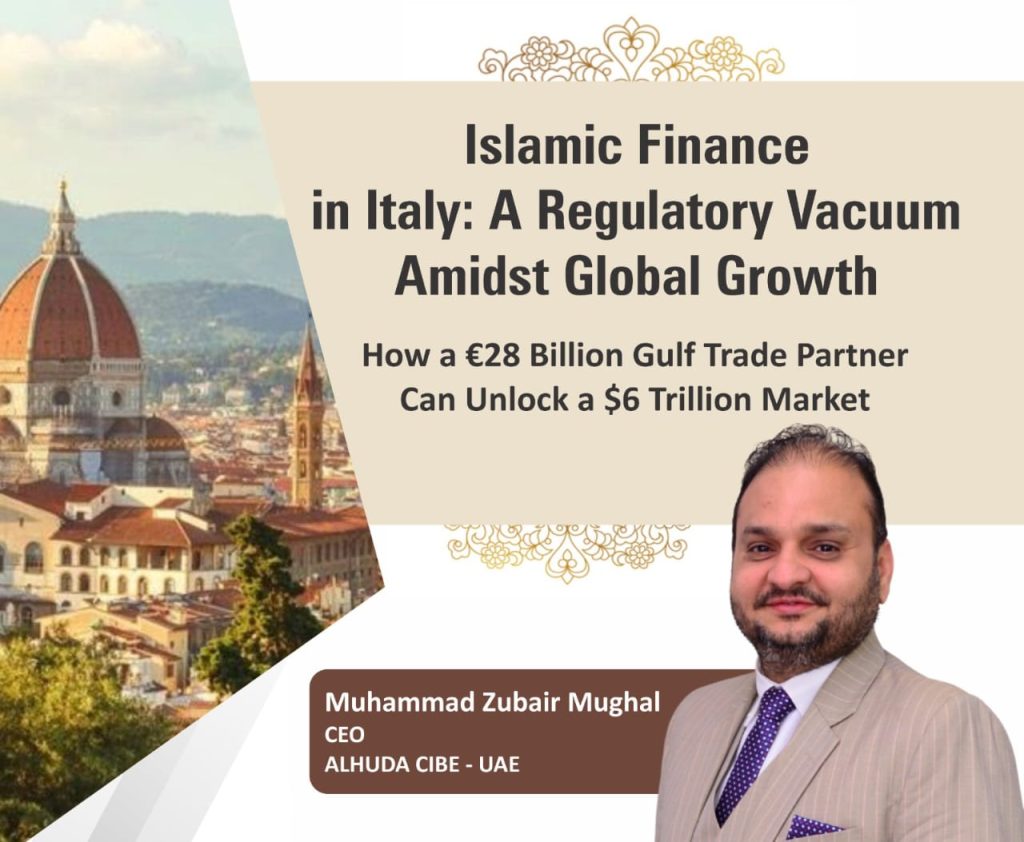
 By: Zubair Mughal, CEO – AlHuda CIBE, UAE
How a €28 Billion Gulf Trade Partner Can Unlock a $6 Trillion Market
Global Islamic finance is experiencing a remarkable growth phase, with total assets reaching
approximately USD 5.2 trillion in 2025, reflecting a year-on-year increase of 14.9%, and is projected to
hit the USD 6 trillion mark by 2026. The global sukuk market also reached record levels, with total
issuance soaring to USD 264.8 billion in 2025, and some reports even citing figures exceeding USD 300
billion, representing a 25% year-on-year increase. While the epicenter of this growth remains in core
Islamic finance countries, the industry is also extending its reach into Western markets, with Europe
presenting a highly fragmented yet dynamic landscape.
The United Kingdom continues to serve as the undisputed Western hub, hosting five fully-fledged
Islamic banks, while the UK Islamic finance market itself was valued at approximately USD 7.81 billion in
2025. The London Stock Exchange remains the largest listing venue globally for hard-currency sukuk,
with over a 40% market share. Meanwhile, smaller European jurisdictions such as Luxembourg have
successfully leveraged their sophisticated fund industries to list green sukuk, and Malta recently
published a consultation proposing definitive regulatory pathways for sukuk issuance and listing.
In stark contrast to these European competitors, Italy presents a unique paradox. The country is home
to a significant Muslim population of approximately 1.7 million, which now constitutes over 30% of the
foreign resident demographic. It is also the second most practiced religion in the country, second only to
Christianity. Deep and growing trade ties with the Gulf region further underscore the missed
opportunity, as Italy trade with the Middle East is substantial. In 2025, Italy exports to the broader
Middle East region, including Israel and Lebanon, exceeded €28 billion. Trade with the UAE alone is
particularly robust, with exports projected to exceed €9 billion in 2025, after reaching €7.8 billion in
2024. In the first half of 2025, non-oil trade between the UAE and Italy reached approximately €6 billion.
Similarly, Saudi Arabia, Italy’s 19th-largest export market, imported €6.3 billion worth of Italian goods in
2025, a 1.5% increase from the previous year. Furthermore, the growing halal market in Italy itself, with
the halal meat market alone valued at USD 697.57 million in 2024 and projected to reach USD 789.46
million by 2027, signals a significant internal demand for Sharia-compliant products.
Despite these compelling indicators, Italy has made no meaningful legislative progress towards
accommodating Islamic finance. It has no enabling law for sukuk, no Sharia governance framework, and
no tax equalization for Murabaha transactions, leaving it in a state of regulatory inertia. A notable
development, however, occurred in February 2025, when Italy’s development finance institution,
CassaDepositi e Prestiti (CDP), signed a Memorandum of Understanding (MoU) with the Islamic
Development Bank (IsDB) Group. This marks the first collaboration initiative between the two financial
institutions. The partnership focuses on knowledge-sharing, co-financing, and co-investment in sectors
such as environmental sustainability, energy, food security, and infrastructure, aligning with Italy’s
Mattei Plan for Africa. While this represents a significant diplomatic step, it does not yet address the
domestic regulatory vacuum.
On the regulatory front, Legislative Decree No. 208 came into force on January 9, 2026. Though not
addressing Islamic finance directly, it signals Italy’s broader financial evolution. Academic and policy
dialogue is slowly advancing: Deputy Minister Maurice Leo stated in 2025 that “Italy can be an important
interlocutor for Islamic finance,” while the University of Salento and ICC Italia now offer courses on the
subject. Still, the gap between talk and legislative action remains wide.
The potential for Islamic finance to aid financial inclusion for Italy’s 1.7 million Muslims is gaining
attention, as conventional interest-based banking is not Sharia-compliant. The Takaful insurance market
is also growing. This dual opportunity—serving the Muslim community and attracting Gulf
investment—makes reform compelling. The cost of inaction is high: Italy loses Gulf FDI and fails to serve
its halal economy (worth ~USD 4 billion), while smaller European jurisdictions move ahead to capture a
share of the $6 trillion global Islamic finance market.
In the global effort to develop Islamic finance ecosystems, AlHuda Centre of Islamic Banking and
Economics (AlHuda CIBE) has emerged as a pivotal player. As a globally recognized organization with
extensive experience across Asia, the Middle East, Africa, and Europe, AlHuda CIBE provides state-of-
the-art advisory consultancy and education in Islamic banking and finance. The center has worked with
central banks, commercial banks, and government entities to design regulatory frameworks, develop
Shariah-compliant financial products, and build local capacity.
Its recent engagements include supporting Somaliland in developing a comprehensive Islamic banking
and capital market ecosystem, including sovereign sukuk structures, advising Punjab Provincial
Cooperative Bank on its transition to a fully Shariah-compliant model, and stepping in to support
Uzbekistan’s emerging Islamic finance industry through training, capacity building, and Shariah advisory
services. With over twenty years of global experience, AlHuda CIBE continues to promote ethical and
Shariah-compliant financial systems by supporting institutions that aim to integrate innovation with
strong governance and compliance foundations. For Italy, which currently lacks domestic Sharia scholars
and regulatory expertise, engaging with such established global advisory centers could provide a
shortcut to developing the necessary institutional and human capital for a future Islamic finance sector.
(Zubair Mughal is a prominent global expert in Islamic Banking and Finance and currently
serves as CEO of AlHuda Centre of Islamic Banking and Economics (UAE). He can be reached
at zubair.mughal@alhudacibe.com