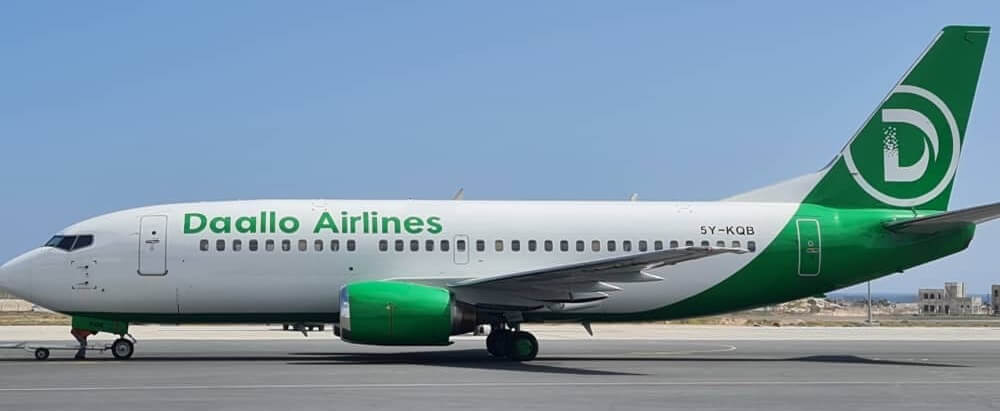

Israel Recognized Somaliland. Why Is Africa Afraid to Follow?
Recognition is not destabilization. Refusing reality is.
Israel did what Africa’s diplomatic class has refused to do for more than three decades. It recognized reality.
On December 26, 2025, Israel became the first United Nations member state to recognize Somaliland as an independent and sovereign state. Prime Minister Benjamin Netanyahu, Foreign Minister Gideon Sa’ar, and Somaliland President Abdirahman Mohamed Abdullahi signed a joint declaration of mutual recognition, with Israel framing the decision in the spirit of the Abraham Accords and pledging cooperation in agriculture, health, technology, and the economy. Reuters reported the recognition and the immediate diplomatic backlash from Somalia, Egypt, Turkey, Djibouti, and the African Union.
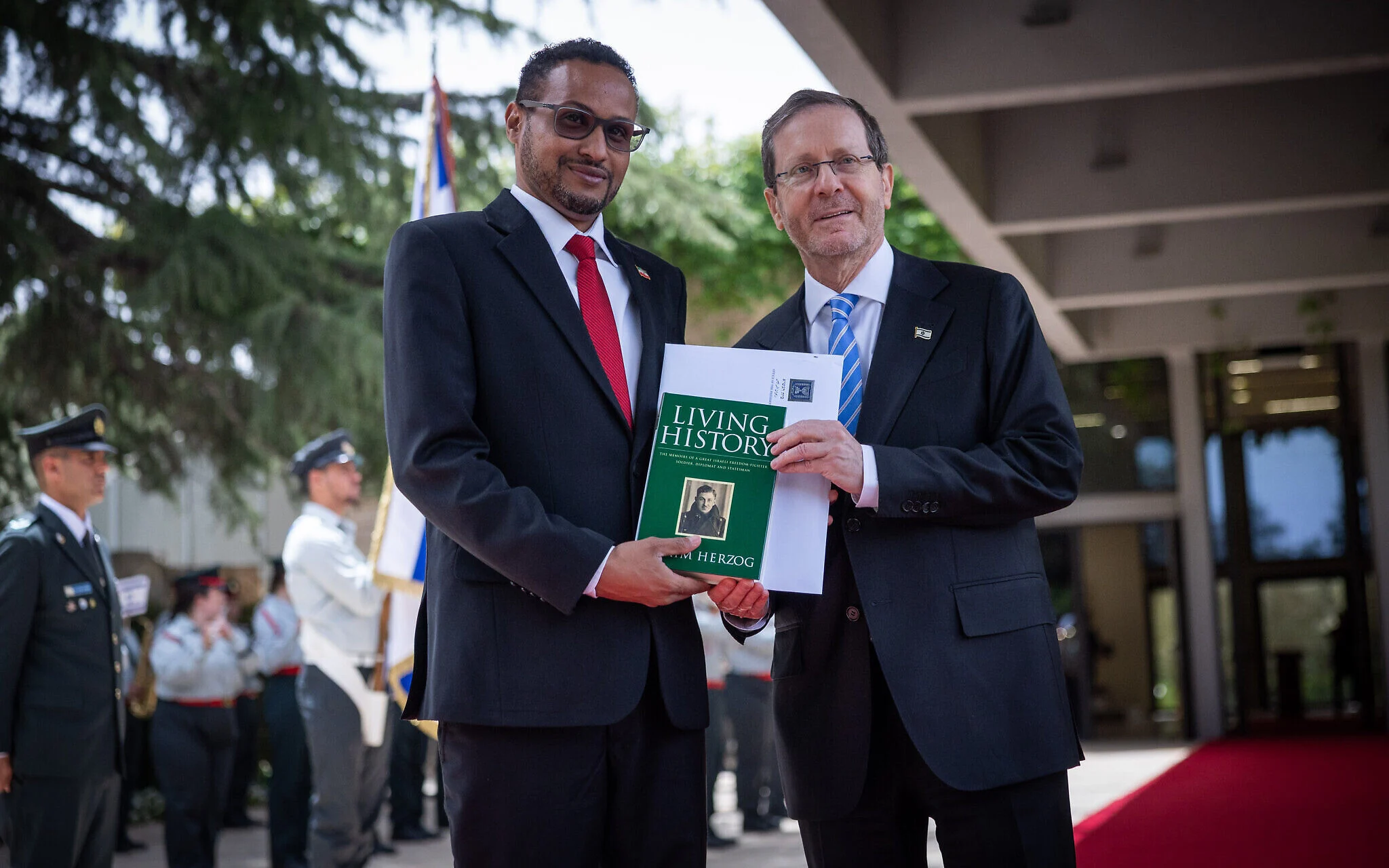
That recognition has now hardened into formal diplomatic architecture. On May 18, 2026, the thirty-fifth anniversary of Somaliland’s declaration of independence, Dr. Mohamed Hagi presented his credentials to President Isaac Herzog in Jerusalem as the first ambassador Somaliland has ever stationed in any foreign country. The Presidential orchestra played Somaliland’s national anthem for the first time on Israeli soil. Foreign Minister Gideon Sa’ar received Hagi later the same day. In April, Israel had named veteran diplomat Michael Lotem as its first ambassador to Somaliland. The relationship is no longer a December headline. It is operative. The Times of Israel reported the ceremony as the formal opening of a partnership covering development, political cooperation, security cooperation, and people-to-people relations.
The question is not whether the backlash was predictable. It was. The question is whether the backlash was honest.
Somaliland declared independence from Somalia in 1991. Since then, it has maintained its own government, institutions, elections, security structures, ports, currency, and foreign relationships. It has functioned as a state while the world refused to call it one. The international system looked at order and called it illegitimate. It looked at collapse and called it sovereignty.
That is not law. It is superstition.
The classic legal test for statehood is found in the 1933 Montevideo Convention on the Rights and Duties of States, which requires a permanent population, a defined territory, government, and capacity to enter into relations with other states. Somaliland meets that test more convincingly than many entities treated as states or near-states by the international community.
It has a population. It has territory. It has a government. It has shown capacity for external relations. It has also done the harder thing: it has survived.
The contrast with Palestine exposes the dishonesty. The Palestinian entity fails the Montevideo test on multiple grounds. It has no defined territory: its claimed borders are contested and unsettled. It has no single functioning government: the Palestinian Authority controls fragments of the West Bank, Hamas and successor factions hold sway over Gaza, and the two have no integrated political order. It has limited capacity to conduct external relations independent of those it claims as adversaries. As of September 2025, 156 of 193 UN member states had nonetheless extended formal recognition. Somaliland, which meets all four Montevideo criteria, had received none. The asymmetry cannot be defended on legal grounds. It is the Palestine Precedent operating in reverse: when statehood is conferred on entities that fail the test, it cannot honestly be withheld from peoples that pass it.
The refusal to recognize Somaliland has never been about whether Somaliland functions. It has been about cowardice. African governments fear that recognition of one successful breakaway state will encourage other peoples trapped inside inherited borders to ask the same question.
They are right to fear the question. They are wrong to suppress it.
Africa’s borders were not drawn by African consent. They were drawn by empire. In 1964, the Organization of African Unity adopted the Cairo Declaration, affirming respect for borders inherited at independence. That doctrine was created to prevent interstate war after decolonization. Its stabilizing purpose was understandable. Newly independent African states did not want the continent consumed by border conflict.
That doctrine also carried an ideological inheritance. It was adopted at the height of the Cold War, when Soviet-aligned regimes across Africa relied on the principles of unconditional non-interference and inviolable colonial borders to consolidate power against domestic challenge. The framework outlived its sponsor. The Soviet Union collapsed in 1991. The African insistence that colonial borders are sacred regardless of what happens inside them did not.
But a doctrine created to prevent war has too often become a doctrine used to preserve injustice.
The inherited-border principle may prevent one kind of instability. It can also entrench another: forced unity over peoples who never consented to be governed together, minorities trapped inside hostile states, regions punished for their identity, and communities told that their suffering is less important than the map.
This is the Universal Fragmentation Doctrine: a border drawn without the consent of the peoples inside it carries no moral weight greater than the human dignity of those it confines. I have set out the full architecture of this doctrine in The Necessary Fragmentation of Africa.
That is where Somaliland matters. Somaliland does not represent chaos. It represents the possibility that African political order can be based on facts rather than slogans. It shows that a people can build institutions, maintain security, and govern itself for decades while diplomats continue reciting formulas from 1964.
Israel saw the facts.
Israel also saw the geography. Somaliland sits near the Red Sea, the Gulf of Aden, Yemen, the Houthis, and critical maritime routes. Recognition was not charity. It was strategic seriousness. Israel understood that a functioning partner in a dangerous region may matter more than the approval of governments committed to preserving failed assumptions.
That is exactly why the opposition to Israel’s decision is revealing. Critics call recognition destabilizing because it challenges their preferred fiction. But what has non-recognition stabilized? Somalia has not been restored by denying Somaliland. The Horn of Africa has not been made safer by pretending Somaliland does not exist. African self-determination questions have not disappeared because diplomats refuse to say their names.
They have only been pushed underground.
Recognition is not always the answer. Not every separatist movement has a valid legal claim. Not every grievance justifies statehood. Fragmentation can be violent, ethnic, opportunistic, or externally manipulated. International law is right to be cautious.
But caution is not the same as paralysis.
The proper question is not whether borders should always change. They should not. The proper question is whether any border should be treated as sacred when it permanently traps a functioning people inside a political order that has failed them.
Israel answered that question with Somaliland.
That answer should matter to Mthwakazi.
Mthwakazi is not Somaliland. It has not yet built Somaliland’s institutions, territorial administration, or diplomatic network. But it is asking a related question: when a people claims historical injury, continuing marginalization, cultural harm, and failed internal remedies, does the world have any obligation to listen before repression escalates?
The answer must be yes.
South Sudan proved that African borders can change. Somaliland proves that African peoples can govern themselves even while recognition is withheld. Mthwakazi is now asking whether peaceful legal advocacy will be heard before threat becomes violence.
That is the link.
Israel’s recognition of Somaliland should not be treated as a diplomatic scandal. It should be treated as a precedent of realism. It says Africa’s future cannot be built forever on the worship of colonial lines. It says functioning peoples deserve to be judged by their institutions, not erased by inherited maps. It says sovereignty must mean more than the right of weak or abusive states to imprison peoples inside legal fictions.
Africa is afraid to follow because Africa knows what follows.
If Somaliland is seen, others may ask to be seen. If South Sudan could vote, others may ask why they cannot. If Mthwakazi can petition, others may ask why peaceful advocacy should be met with threats. If recognition is tied to function, consent, and justice rather than inherited borders alone, then the entire post-colonial settlement becomes open to moral audit.
Good.
That audit is overdue.
Israel has shown that recognition can be an act of courage and clarity. It did not create Somaliland. Somaliland created itself through endurance. Israel simply had the honesty to say so.
Africa should learn from that honesty.
Recognition is not destabilization.
Refusing reality is.