
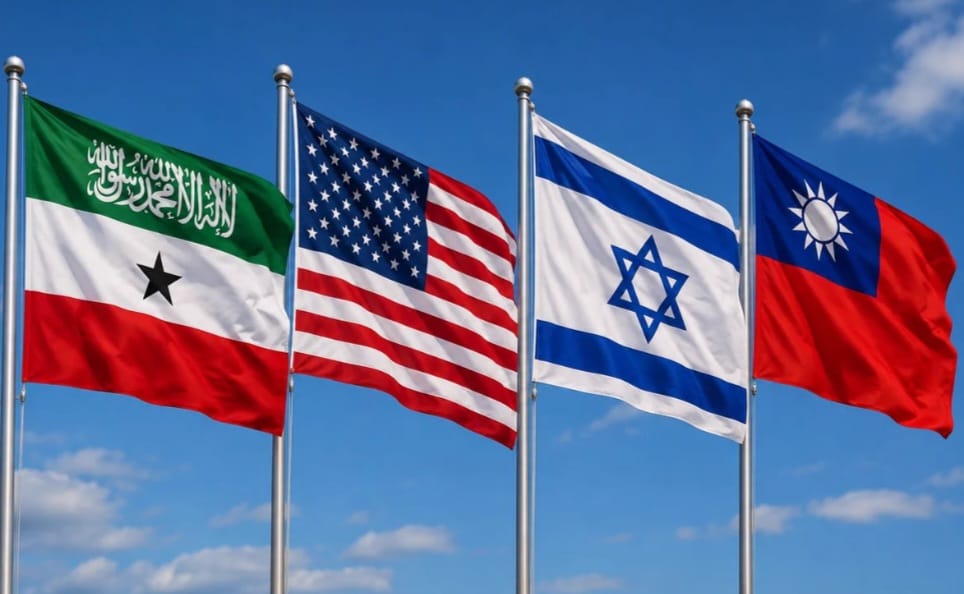
The Republic of Somaliland, Taiwan, and Israel’s relations represent more than shared democratic values. They point toward an emerging strategic alignment among three democratic nations positioned at critical maritime crossroads, with the United States as a natural and indispensable strategic partner.
As former President Tsai Ing-wen stated, “Somaliland and Taiwan are bonded by shared democratic values and freedoms.” Taiwan’s current president, William Lai Ching-te, has also called for cooperation with like-minded countries, including the United States, toward a “non-red Somaliland coastline.”
#Israel has taken the most significant diplomatic step by formally recognizing Somaliland as an independent and sovereign state. Prime Minister Benjamin Netanyahu described the move as being in the spirit of the Abraham Accords and pledged expanded cooperation in agriculture, health, technology, and the economy. During President Cirro’s 2026 visit to Israel, Netanyahu further highlighted Somaliland’s strategic position at the opposite end of the Red Sea, adjacent to the Bab el-Mandeb, one of the world’s most important maritime gateways.
The strategic geography is compelling. Taiwan is central to the security of the Indo-Pacific. Israel is a key U.S. partner in the Middle East. Somaliland sits at the gateway between the Gulf of Aden, Bab el-Mandeb, the Red Sea, and the Indian Ocean.
Together, these relations connect three strategically vital regions and create an emerging network of democratic partnerships around some of the world’s most important maritime corridors.
For #Washington, Somaliland should therefore be viewed not simply through the question of recognition but as a potential strategic partner in democracy, maritime security, freedom of navigation, counterterrorism, and the protection of global trade routes.
The Somaliland-Taiwan-Israel relations demonstrate how shared democratic values can evolve into strategic cooperation. The opportunity now is for the United States to recognize Somaliland’s strategic value and engage accordingly.
Abdirashid Ibrahim